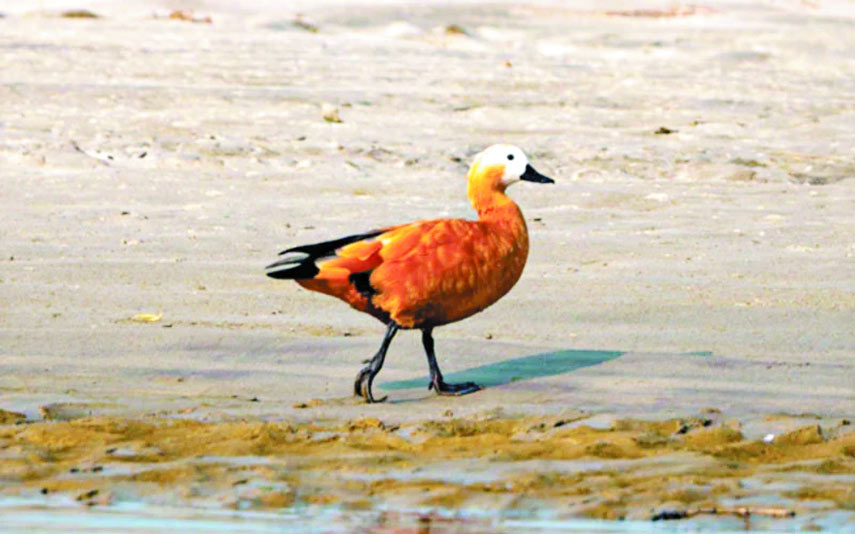
I came to the Dogar Ghat in the city's Char Satbaria area to go to Char No. 10 on the Padma River in search of rare birds. I was accompanied by Rajshahi bird photographer Maruf Rana and two associates, along with Chuadanga bird and wildlife lover Bakhtiyar Hamid. At exactly 8:30 in the morning, the elderly boatman Jakarul Majhi left the boat. After moving forward a little, I saw a small flock of the bird that keeps the Padma River mesmerized with the sound of 'Aakh-Aakh...' all the time in the winter. From then on, until I reached Char No. 10, I kept seeing one, two, five reddish-orange birds one after another.I came to Char No. 10 on the Padma in search of several rare birds, including the Shyamla Kankal. I was here for five hours. The char, full of plum, acacia, shimul, akanda and bushes, looks like some African savannah.On the way back, I again saw the beautiful reddish birds scattered across the river. Some were floating in the river water, some were walking on the sand of the char, and some were flying in the sky above the river. The next day, I went to Charil Beel in Rohanpur, Gomostapur Upazila of Chapainawabganj and saw a huge flock of them. For the past decade, I have been seeing these birds in the Padma River of Rajshahi in winter. I don't know why I don't like going to the Padma without seeing the reddish-orange birds.These birds of the Padma River of Rajshahi are a species of migratory duck in this country, Chakhachkhi. These commonly seen ducks are also known as Chakhachkhi, Chaka-Chaki, Lal Chakha, Lala or Manikjod Han. The English name is Ruddy Shelduck or Brahminy Duck. The scientific name of this bird of the Anatidae or duck family is Tadorna ferruginea. It is widespread from southeastern Europe to Central Asia, Lake Baikal and Mongolia to western China. However, some resident birds are also seen in West Africa and Ethiopia. They migrate to the Indian subcontinent including Bangladesh in winter.The body length of an adult shelduck is 58-70 cm, the spread wingspan is 110-135 cm and the weight is 925-1,640 g. The shelduck is quite different from other migratory ducks in body color and shape. Although the ducks and geese look almost the same, the duck is slightly larger in size. The duck's feathers are rusty-orange, the face is white, the head and neck are yellowish-brown. The wing coverts are white, the end feathers and tail are black. The bright green flag of the wing is clearly visible when flying. A black garland is seen on the neck during the breeding season. The face of the duck is very white, the head is pale and there is no garland on the neck. Regardless of the duck, both have brown eyes. The beak, legs and feet are black. Immature ducks look like ducks, but pale. The back is brown, the feathers at the base of the wings and the wing coverts are gray.In winter, they are seen roaming in the rivers and water bodies of the entire country. They usually roam in pairs or small groups.
They search for food in mud and shallow water. They eat aquatic weeds, plants, fish, frogs, insects, snails, crabs, etc. They call ‘chur-chur-chur...’ or ‘aakh-aakh...’ while flying and ‘angk-angk-angk...’ when scared.May to June is the breeding season. At this time, they dig a hole in the sandy or muddy bank of a lake or water body located in the high plateau of their main habitat area and build a nest with their fallen breast feathers. The female duck lays 8-9 white eggs. The female duck guards the nest and incubates the eggs alone. The eggs hatch in 28-29 days. It takes 55-60 days for the chicks to learn to fly and become independent. Lifespan is 10-15 years.
Author: Bird and Wildlife Breedingand Medical Specialist