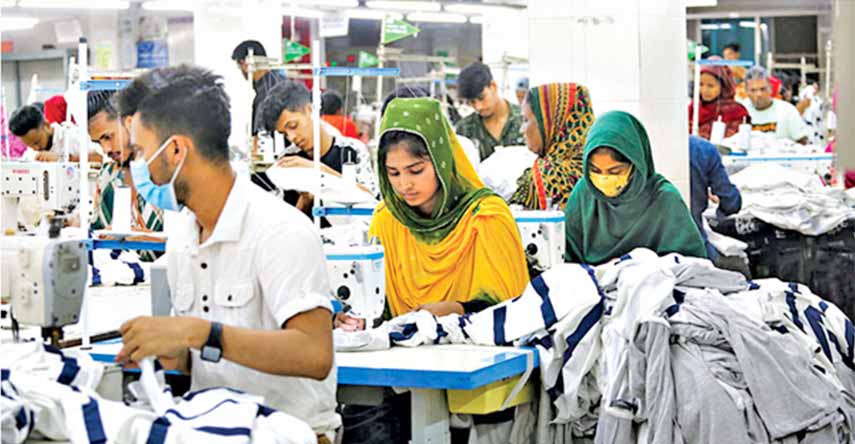
Bangladesh has moved ahead of China to become the second-largest exporter of readymade garments (RMG) to the United States, as steep retaliatory tariffs imposed by the Trump administration sharply reduced Chinese apparel shipments to the American market.
According to the latest data released by the Office of Textiles and Apparel (OTEXA) under the US Department of Commerce, Bangladesh strengthened its position in the US apparel market by the end of March this year, while Vietnam retained its position as the top exporter.
The OTEXA data showed that US importers purchased apparel products worth US$17.73 billion from global suppliers during the January-March period of the current year, marking an 11.60 percent decline compared to the same period last year.
Among the top five apparel-exporting countries to the US market, only Vietnam recorded positive growth during the first quarter. Exports from China, Bangladesh, Indonesia, and India all declined year-on-year.
Bangladesh exported apparel worth US$2.04 billion to the United States during January-March, down 8.38 percent from the same period last year. Bangladesh had exported garments worth US$8.20 billion to the US market in the previous calendar year.
Despite the decline, Bangladesh overtook China as Chinese exports suffered a dramatic fall following retaliatory tariff measures. China's apparel exports to the US plunged nearly 53 percent during the first three months of the year, dropping to US$1.70 billion from US$3.61 billion in the corresponding period of the previous year.
Vietnam maintained its lead in the US apparel market with exports worth US$3.98 billion during January-March, registering a 2.73 percent growth year-on-year. Vietnam currently holds around 22 percent of the US apparel import market, while Bangladesh's market share stands at approximately 11.5 percent.
Indonesia exported apparel worth US$1.22 billion during the first quarter, slightly down by 0.13 percent from US$1.23 billion recorded a year earlier.
India experienced a steeper decline than Bangladesh. The country exported apparel worth US$1.10 billion to the US market during January-March, compared to US$1.51 billion in the same period last year, representing a 27 percent decline.
The changing trade dynamics come in the wake of retaliatory tariff measures introduced by US President Donald Trump on April 2 last year against products from 157 countries. Although the tariffs were initially scheduled to take effect from April 9, implementation was later postponed for three months to allow bilateral negotiations.
At the beginning, Bangladeshi products faced a 37 percent retaliatory tariff, which was later reduced to 35 percent on July 8 following negotiations and commitments by Bangladesh to increase imports from the United States through both government and private sector channels. The tariff was subsequently lowered further to 20 percent, which became effective on August 7.
Later, Bangladesh signed a reciprocal trade agreement with the United States on February 9, under which the retaliatory tariff rate on Bangladeshi products was reduced to 19 percent.
However, in the third week of February, the US Supreme Court declared the retaliatory tariffs imposed on several countries, including Bangladesh, illegal. In response, President Trump announced a fresh 10 percent tariff under the Trade Act of 1974, which came into effect on February 24. Last Thursday, the US Court of International Trade suspended the new tariffs in cases involving two private importing firms and Washington State.
Initially, Bangladesh faced uncertainty due to the tariff proposals, but later gained a relatively favourable position compared to competing exporters. Vietnam faced a similar 20 percent tariff rate, while Indian products were subjected to a combined tariff burden of around 50 percent. China's tariff rate remained significantly higher.
As a result, Bangladesh initially saw an increase in purchase orders for garments, footwear, and other products. However, exporters say the momentum did not continue for long as rising tariffs increased product prices, while higher global energy costs following the Iran conflict intensified inflationary pressure in major consumer markets, reducing demand and slowing new orders.
Industry insiders believe Bangladesh's improved position in the US market demonstrates the sector's resilience and competitiveness despite global economic uncertainty. However, they warned that sustaining growth will depend on stable trade policies, competitive pricing, and stronger market diversification in the coming months.