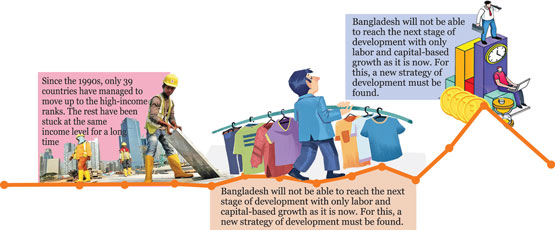
Cheap labor, second-largest ready-made garment exports, expatriate income, and strong domestic consumption-these four-power economic models have elevated Bangladesh from a low-income country to a lower-middle-income economy in the last three decades.
But in the third decade of the 21st century, with the rapid changes in the global economy, this model is now in question. According to domestic and foreign analysts and international organizations, Bangladesh will not be able to reach the next stage of development with only labor and capital-based growth as it is now. For this, a new strategy of development must be found.
The model of development followed for so long has reduced poverty in Bangladesh and increased the gross national income per capita to 3,020 US dollars. The size of the economy is now close to 500 billion dollars. But the calculation of development is no longer limited to the size of GDP or per capita income. The World Bank’s latest annual research report on this matter, ‘The Middle Income Trap’ (2024), says that the three pillars of the new equation for development in middle-income countries are investment, technology adoption and diffusion, and innovation. While investment in low-income countries creates growth momentum, the capacity to adopt technology and innovate must be increased to move from lower-middle income to upper-middle income and then to high income. Otherwise, productivity will stagnate and the economy risks getting stuck in the middle-income trap.
Currently, there are about 6 billion people living in 108 middle-income countries, which is about 73 percent of the world’s population. Since the 1990s, only 39 countries have managed to move up to the high-income ranks. The rest have been stuck at the same income level for a long time.
Bangladesh is also at that juncture. The government has set a goal of becoming an upper-middle-income country by 2031 and a high-income country by 2041. According to the World Bank’s current classification, a country’s per capita gross national income (GNI) of $4,636 is required to become an upper-middle-income country and $14,376 is required to become a high-income country. According to economists, changing the structure of growth rather than increasing the growth rate is a bigger challenge to meet this goal.
This idea is also reflected in the country’s macroeconomic indicators. The economic growth, which was once more than 7 percent, has recently fallen below 4 percent. Long-term inflation, pressure on foreign exchange reserves, a weak banking sector and slow investment have put pressure on the economy. Private investment has been stagnant at around 24 percent of GDP for several years; even in the latest full-year figures, it has fallen to 22 percent. Net foreign investment is still below 1 percent of GDP. The tax-GDP ratio is also lower than in many Asian countries.
This reality is also reflected in the assessments of international organizations. The World Bank, IMF, and ADB say that it will be difficult for Bangladesh to move towards high growth and high income without restoring macroeconomic stability, as well as financial sector reforms, increasing productivity, adopting technology, and increasing private investment.
Former Director General of Bangladesh Institute of Development Studies (BIDS) Dr. Mustafa K. Mujeri told Daily Industry, ‘In the history of development, those countries have been successful which have been able to change the character of growth in time. Bangladesh now faces the same test - to build the foundation of new growth while maintaining the strength of conventional growth.’
An analysis by the ‘Atlas of Economic Complexity’ of the Harvard Growth Lab in the United States says that for long-term growth, not only the overall volume of exports but also the share of technology-based and high-value-added products must be increased.
Nearly 80 percent of Bangladesh’s export earnings still depend on the ready-made garment sector. Diversifying exports and developing new high-value-added industries has been slow.
Dr. Zahid Hossain, former chief economist at the World Bank’s Dhaka office, said the country’s biggest challenge now is not to increase growth, but to create new sources of growth. Without rapid progress in these four areas-technology adoption, productivity growth, efficient institutions, and private investment-the journey to high income will be long.
The experience of some successful economies in Southeast and East Asia suggests the same message. South Korea, Singapore, and Taiwan have all moved to the next stage of development by transforming from labor-intensive manufacturing to technology-intensive industries. A recent example is Vietnam. The country has moved from a lower-middle-income country to an upper-middle-income economy this year, thanks to manufacturing-oriented foreign investment, an expansion of the electronics industry, and integration into global supply chains.
However, this experience has also made clear another point - for the desired development, macroeconomic stability and continuous structural reforms are also required. Dr. Debapriya Bhattacharya, Special Fellow at the Center for Policy Dialogue (CPD), said that for sustainable growth, macroeconomic stability and structural reforms must be taken forward together. According to him, unless inflation control, financial sector discipline and policy predictability are ensured, private investment will not increase, and productivity will not increase to the desired level.
On the positive side, the government’s reform program reflects these observations and assessments of domestic and foreign analysts. The budget for the fiscal year 2026-27 has prioritized banking sector reforms, modernization of revenue administration, creation of an investment-friendly environment, export diversification, and technology-based industrialization. In addition, initiatives have been taken to increase spending on education, skill development, health, and infrastructure to strengthen the foundation of productivity in the long term.
Finance Minister Amir Khasru Mahmud Chowdhury said that to bring the economy back to a high growth trajectory, the government is giving equal importance to both short-term macroeconomic stability and long-term structural reforms. Increasing productivity, diversifying exports, improving competitiveness, and expanding private investment will be the focus of the economic strategy for the next decade.
However, the big question now is how effective the government’s policy announcement will be in practice. According to Bangladesh Bank data, credit growth in the private sector has slowed significantly compared to before. At the same time, the pace of new investment is slowing due to rising production costs, energy uncertainty and rising financing costs.
Metropolitan Chamber of Commerce and Industry (MCCI) President Kamran T Rahman said investors want policy continuity, uninterrupted energy, fast service and long-term policy certainty. According to him, if these are ensured, domestic and foreign investment will naturally increase; technology will also come, which will increase productivity.
Economists say Bangladesh still has opportunities ahead. A large domestic market, a young population, a geographical location, a strong industrial base, and long experience in global supply chains all provide the foundation for the country’s future potential. But without timely decisions, effective institutions, and consistent reforms, potential will never become reality.