Despite being a market with huge potential, Bangladesh’s exports to SAARC (South Asian Association for Regional Cooperation) countries are still stuck in a limited range. Export earnings have hovered around $2 billion for five years.
For several years, there has been no visible progress in Bangladesh’s export growth in the markets of the other seven SAARC countries - India, Pakistan, Sri Lanka, Nepal, Bhutan, Maldives and Afghanistan. In the just-ended fiscal year, Bangladesh’s export earnings in the SAARC region fell by 0.38 percent to $1.98 billion.
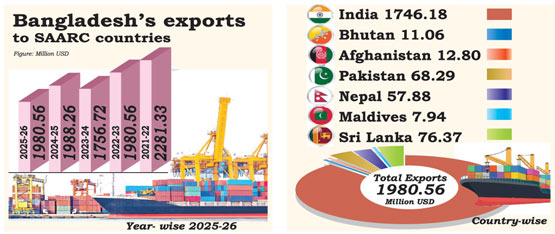
According to data from the Export Promotion Bureau (EPB), export earnings from SAARC countries in the last fiscal year 2025-26 were $1.98 billion, slightly less than the previous fiscal year. Bangladesh’s total exports from the countries in the fiscal year 2021-22 were $2.28 billion.
In the next fiscal year 2022-23, it decreased to $1.99 billion. In the fiscal year 2023-24, it decreased further to $1.76 billion. However, in the fiscal year 2024-25, there was a slight turnaround and exports of goods worth $1.99 billion were recorded.
Bangladesh’s exports to the SAARC market have remained almost flat over the past five years, with exports falling by about $300 million in the 2025-26 fiscal year compared to $2.28 billion in the 2021-22 fiscal year.
More reliance on Indian market
India is Bangladesh’s largest export market among the SAARC countries. However, despite being a large market, exports to the country have decreased compared to the last fiscal year.
Bangladesh’s exports to India were $1.76 billion in the 2024-25 fiscal year. It decreased to $1.74 billion in the 2025-26 fiscal year. About 88 percent of Bangladesh’s total exports in the SAARC region go to the Indian market.
Although ready-made garments dominate the global export market, ready-made garments are not the only source of Bangladesh’s export income in the Indian market. Bangladesh exports a variety of products to the country’s market, which generates a significant amount of revenue.
Of the total export earnings, $571 million came from the ready-made garment sector. Of this, $244 million came from knitwear products and $346 million from woven garments. In addition, Bangladesh has earned $135 million from textile exports to the Indian market. Apart from this, Bangladesh has earned $96 million from footwear exports, $125 million from edible fruits and nuts, $62 million from leather products, $20 million from raw hides, $183 million from vegetable textile fibers, $43 million from iron and steel products, $72 million from fish exports, $17 million from vegetable fats and $30 million from starch products.
Export picture to other countries
Exports to Sri Lanka and Pakistan also declined. Exports to Sri Lanka fell from $82.85 million to $76.37 million. Exports to Pakistan fell from $73.99 million to $68.29 million.
Bhutan’s exports have also declined. While the country exported goods worth $14.32 million in the 2024-25 fiscal year, it fell to $11.06 million in the 2025-26 fiscal year.
However, some smaller markets have seen positive growth. Bangladesh’s exports to Nepal increased from $35.40 million to $57.88 million. Exports to Maldives increased from $6.34 million to $7.94 million. Exports to Afghanistan also increased from $11.09 million to $12.80 million.
Why aren’t exports to SAARC growing?
Exporters say that despite being geographically close, Bangladesh’s exports to the SAARC region are not growing at the desired rate. One of the reasons for this is the lack of product diversity, regional trade barriers, tariff and non-tariff barriers, and weak supply chains.
Although ready-made garments are Bangladesh’s main export product, the demand for garments in the SAARC countries is limited. In these countries, there is potential for various products, including food products, medicines, agricultural products, light engineering products, along with Bangladesh’s ready-made garments. But the pace of export expansion in these sectors is slow.
Economists say that to increase trade in the SAARC region, it is necessary to create new products and new markets, rather than relying solely on traditional products. It is also necessary to develop regional communication systems, facilitate border trade, and implement trade agreements.
What to do next?
According to exporters and economists, several issues need to be prioritized to strengthen Bangladesh’s position in the SAARC market.
First, beyond clothing, exports of medicines, agricultural products, processed foods, leather, shoes, IT services, and light engineering products must be increased.
Secondly, product development and marketing strategies must be tailored to the market needs of neighboring countries.
Third, it is important to reduce the complexity of border trade, create a rapid goods transportation system, and increase regional trade cooperation.
We must adopt competitive products, easy trade arrangements, and long-term export strategies, rather than relying solely on geographical proximity.
What the experts say
To increase Bangladesh’s exports to the SAARC market, exports of non-traditional products such as pharmaceuticals, processed food, agricultural products, leather and leather products, light engineering products, plastics, ceramics, and IT services, apart from ready-made garments, need to be increased.
At the same time, it is essential to develop production and quality control systems to meet the market needs, standards, sanitary and phytosanitary (SPS) and other technical requirements of each country. It is possible to strengthen Bangladesh’s position in the SAARC market not only by ensuring geographical proximity, but also by ensuring competitive products and international standards.
Although there is considerable potential to increase Bangladesh’s exports of non-garment products to SAARC countries, that potential is not being fully utilized due to the political situation, tariff and non-tariff barriers, and various complications of border trade, said Kamruzzaman Kamal, Director (Marketing) of PRAN-RFL Group.
He told Daily Industry, "Although India is the largest market in the SAARC region, exports have been significantly affected in the last few years due to political tensions, closure of land ports and various restrictions. On the other hand, political instability in Afghanistan and Pakistan has also become an obstacle to expanding trade in these markets."
Kamruzzaman Kamal said, "Bangladesh lags behind in the competition due to special tariff structures in markets like Nepal and Bhutan. Although Nepal provides special trade facilities for India, it imposes additional tariffs and restrictions on imports from other countries. As a result, the competitiveness of Bangladeshi products decreases."
In India, non-tariff or procedural barriers are more problematic than tariffs, the marketing official said. "Exports take two weeks or more due to the limited number of land ports, lengthy customs procedures, and the need to send each food consignment to a laboratory for clearance. This significantly increases transportation costs and business costs."
He also believes that although there is an opportunity to send goods to India from factories near the border in a short time, due to the designated port, goods have to be sent via a long route, which is harming export capacity.
According to him, there is a huge opportunity to increase exports of food products, plastics and other consumer goods in the SAARC region, especially in the field of food. However, to harness this potential, initiatives must be taken to improve political relations, simplify border and port management, and reduce both tariff and non-tariff trade barriers.
Executive Director of the Center for Policy Dialogue (CPD), Dr. Fahmida Khatun told Daily Industry, "Bangladesh’s export earnings in the SAARC countries’ markets have been limited to about two billion dollars for several years. The main reason for this is the similarity in the production structure of South Asian countries and Bangladesh’s inability to build sufficient comparative competitive capacity."
Noting that large economies like India meet a large part of their demand through their own domestic production, he said, "It is difficult for Bangladesh to quickly increase exports to these markets with the same type of products. For this, Bangladesh needs to identify products where it is possible to create special advantages and competitive capabilities."
Fahmida Khatun said, ‘As similar products are produced in South Asian countries, it is not possible to expand exports by relying on conventional products. For this, product diversification, innovation and price competitiveness must be increased. Competition is becoming more difficult as countries like China and Thailand provide diverse products at low prices.’
Stating that the government must be more proactive in strengthening economic diplomacy, developing trade relations and reducing barriers to market entry to expand regional markets, he said, "This will create opportunities for Bangladesh’s exports to increase in the South Asian market."