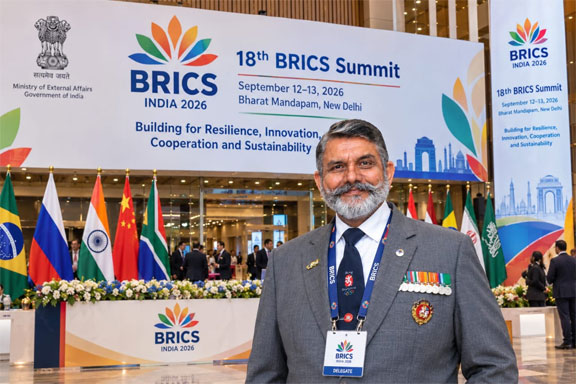
After an all-night diplomatic battle, the 18th BRICS Summit in New Delhi has crossed its most difficult hurdle. India has brought an increasingly divided 11-member grouping to consensus on a common leaders’ declaration, while using its presidency to advance a larger proposition: the Global South should no longer merely live with rules made elsewhere, but should have a decisive voice in making them.
The defining development from Bharat Mandapam on September 12 is the agreement among BRICS members on a joint declaration after negotiations reportedly continued until around 4 a.m. The formal adoption and release of the document by the leaders is still to follow, but the negotiating breakthrough is itself significant. The principal obstacle was West Asia, particularly the sharply differing positions of Iran and the UAE, with Saudi Arabia also bringing its own regional calculations into an enlarged grouping that now contains major geopolitical rivals. Reuters reports that the agreed formulation condemns unilateral war or aggression without naming a particular country, a carefully constructed compromise that allowed all members to accept common language. The achievement is important precisely because BRICS did not reach consensus in May at the foreign ministers’ meeting. India has therefore succeeded not by eliminating disagreement, but by creating language in which countries with fundamentally different positions can still stand together.
India's central diplomatic proposition
Prime Minister Narendra Modi has sought to make the summit about more than BRICS itself. “The Global South is today in the front row when it comes to global crises, but in the back row when it comes to decision-making,” he said, arguing that the international system should become a platform of partnership rather than hierarchy. His more powerful formulation was: “If our future is shared, then the right to shape that future must also be shared.” These words capture the strategic philosophy of India's chairship: reform, rather than replace, the existing international order; give emerging economies greater representation; and make BRICS a practical instrument of Global South influence rather than an anti-Western alliance.
That distinction matters. The enlarged BRICS represents approximately 49.5 percent of the world's population, around 40 percent of global GDP and 26 percent of global trade, according to Indian government figures. Its strength lies in that enormous demographic and economic weight. Its weakness lies in its political diversity. India has therefore had to demonstrate that enlargement need not produce paralysis.
From geopolitical statement to institutional reform
The emerging declaration is expected to reinforce BRICS support for stronger multilateralism, reform of global governance institutions and greater representation for developing countries. India has particularly pressed for UN Security Council reform and support for India's permanent membership, alongside a strong common position against terrorism in all its forms and manifestations. The significance goes beyond Indian diplomacy. The central argument is that the institutions designed after the Second World War no longer adequately represent the economic, demographic and political distribution of power in 2026.
Chinese President Xi Jinping has articulated a related but somewhat different ambition, urging BRICS countries to “firmly stand on the right side of history” and move the international order towards greater equity and justice. China sees BRICS as an important vehicle for restructuring global power; India accepts the need for greater equity but has deliberately avoided turning BRICS into an ideological or geopolitical bloc against the West. That difference may become one of the most important determinants of BRICS' future direction.
The economic architecture is becoming more practical
India's presidency has attempted to move BRICS beyond communiqués towards mechanisms that businesses, investors and governments can actually use. More than 50 practical outcomes, frameworks and initiatives have emerged across the four priorities of Resilience, Innovation, Cooperation and Sustainability. These include the proposed BRICS Incubator Network, a BRICS Startup Innovation Fund, and a Logistics Supply-Chain Cooperation Framework designed to strengthen connectivity, resilience and sustainability. Modi has challenged the BRICS Business Council to help scale 100 startups and create 1,000 new partnerships, giving the economic pillar a measurable objective rather than merely a rhetorical one.
Financial cooperation is moving in the same direction. The practical agenda is not an immediate common BRICS currency, but greater use of national currencies, interoperable payment systems and more efficient cross-border settlement, alongside reform of the IMF, World Bank and other international financial institutions. This is strategically more realistic. If BRICS can reduce transaction costs and build reliable payment connectivity, economic integration can advance without requiring eleven countries to surrender monetary sovereignty.
Supply chains, shipping and the West Asian test
The supply-chain initiative acquires particular importance because geopolitical conflict has increasingly become an economic variable. Energy disruptions, sanctions, shipping insecurity and concentrated manufacturing have demonstrated how quickly political crises can become inflation, insurance and logistics crises. India's proposed emergency-support mechanism for seafarers, together with its emphasis on freedom of navigation and maritime commerce, reflects a practical recognition that BRICS must protect the physical arteries through which its economies function. Modi's discussions with Iranian President Masoud Pezeshkian have likewise stressed dialogue and a diplomatic solution to the West Asian crisis.
The Iran dimension also illustrates India's strategic autonomy. New Delhi is simultaneously engaging Iran, Saudi Arabia and the UAE, maintaining its strategic relationship with Russia, managing a difficult but improving relationship with China, and retaining deep economic and strategic engagement with the United States and Europe. Rather than choosing one geopolitical camp, India is attempting to preserve sufficient relationships with all major centres of power to retain diplomatic room for manoeuvre.
Xi, Putin and India's balancing act
Russian President Vladimir Putin's presence reinforces another dimension of the summit. His discussions with Modi covered defence, trade, energy, space and wider economic cooperation, with both countries pursuing an ambition to raise bilateral trade towards $100 billion by 2030. Modi's continuing engagement with Moscow demonstrates that India's BRICS policy remains anchored in strategic autonomy, even as India's economic and technological integration with Western economies deepens.
Xi's arrival in New Delhi, his first visit to India in seven years, is equally consequential. It comes after the 2020 border crisis but also amid cautious efforts to stabilise bilateral relations. BRICS provides India and China a forum where strategic competition can coexist with institutional cooperation without either relationship being allowed to define the entire architecture. For India, that is precisely the utility of multilateralism.
The invisible diplomacy behind the declaration
The public summit is only the final stage of months of negotiations. India's BRICS Sherpa Sudhakar Dalela, Secretary (Economic Relations), and Sous-Sherpa Shambhu L. Hakki, Joint Secretary in the Ministry of External Affairs, have coordinated the negotiating process. More than 400 BRICS-related meetings across nearly 30 Indian cities have been organised during India's chairship. Dalela described the chair's responsibility in unusually simple terms: “It is our responsibility to make sure that we facilitate dialogue and discussion among all the members.” That sentence effectively describes the diplomatic method that has produced the declaration.
Former G20 Sherpa Amitabh Kant identified the central test before the summit: the outcome document should be “progressive, forward-looking, and yet not be anti-Western.” Former BRICS Sherpa Sanjay Bhattacharyya, meanwhile, described BRICS as a “stabilising force” amid the current geopolitical churn. Together, these assessments capture India's strategic middle path: make BRICS stronger without turning it into a confrontation mechanism.
AI, deep technology and the next Global South frontier
India has also deliberately expanded the BRICS agenda into the technologies that will shape the next international economic order: artificial intelligence, quantum technologies, digital public infrastructure, startups, MSMEs and emerging technologies. At Bharat Mandapam, the Bharat Innovates exposition is showcasing 37 deep-tech innovations, including AI-enabled cervical cancer screening, AI maternal-fetal monitoring, floating solar photovoltaic systems, marine robotics and rare-earth-free electric powertrains. The symbolism is powerful: India wants BRICS cooperation to reach laboratories, entrepreneurs and industrial ecosystems, not remain confined to foreign ministries.
The larger strategic question is therefore no longer whether BRICS can issue declarations. It is whether it can convert its extraordinary demographic and economic weight into institutions that work: cheaper payments, stronger supply chains, development finance, technology partnerships, startup networks, energy security, food and health cooperation and greater influence over global rules.
The verdict from Delhi
The immediate diplomatic verdict is already clear. India inherited an expanded BRICS whose membership had grown faster than its institutional coherence. It has spent its chairship trying to convert enlargement into effectiveness. The hardest test came at the worst possible geopolitical moment: Iran and Gulf states divided over West Asia, Russia and Ukraine still at war, US-China rivalry intensifying, global trade fragmenting and maritime routes under pressure. Yet the members have found sufficient common ground to agree on a collective declaration.
That is India's most important achievement at Bharat Mandapam.
India has not made BRICS homogeneous. It has demonstrated that a heterogeneous BRICS can still negotiate, compromise and speak together.
In an increasingly fragmented international system, that ability may prove more consequential than any single communiqué. The real measure of the 18th BRICS Summit, however, will now be whether the consensus reached in New Delhi survives beyond the conference hall and becomes an architecture of trade, technology, finance, security and institutional reform capable of giving the Global South not merely a larger audience, but a genuine role in shaping the future.