Md. Jewel Ahmed, Court Correspondent
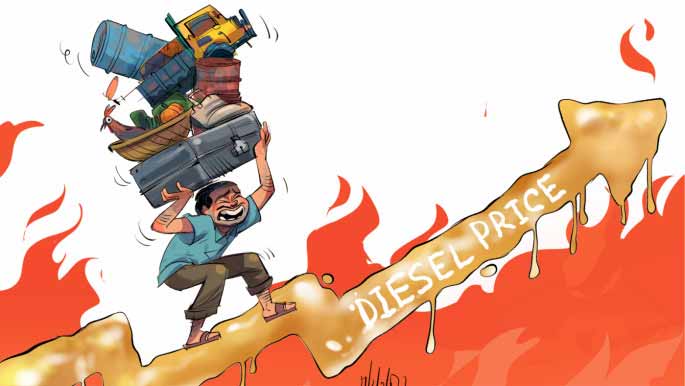
With mounting pressure on the cost of living from electricity, gas, addible oil and daily necessities oil who is keeping track of the household budgets of ordinary citizens? In Bangladesh, fuel price hikes are no longer just news; they have become akin to a seasonal festival. The only difference is that people participate in other festivals with joy, whereas in this "festival" of rising fuel prices, they participate by sighing while calculating future expenses. The government has raised the price of diesel from Tk 115 to Tk 135 per liter in a single leap. Petrol has gone from Tk 140 to Tk 160, and octane from Tk 145 to Tk 165. Kerosene has not lagged behind either, rising from Tk 135 to Tk 155. In short, the price of almost every type of fuel oil has jumped by Tk 20 at once. Why? That question—"why"—is now the most crucial one. The government has its explanations: war is raging in the Middle East, fuel prices and freight charges have risen in the international market, and the Bangladesh Petroleum Corporation (BPC) incurred a loss of approximately Tk 22,875.66 crore between March and August. It was further stated that although international oil prices more than doubled, the government had refrained from raising domestic prices until now in the public interest. It sounds quite noble—the claim that the government held off on price hikes for five months for the sake of the people, effectively keeping them afloat. Today, however, that period of "noble responsibility" has ended. Yet, the ordinary citizen asks: we understand that domestic prices rise when international prices do, but shouldn't the public also know the extent of the international increase and whether the domestic hike is justified? This is precisely where the most peculiar game of the market economy lies. Prices rise domestically when they rise internationally. A jump of Tk 20! It feels less like a fuel price adjustment and more like a new formula in advanced mathematics: buy one liter, and get a package of inflation for free. Of course, the biggest blow of the price hike does not fall on the owners of diesel-powered vehicles; the real impact hits the person who does not own a car at all. Consider the person who boards a bus, buys rice and lentils transported by truck, purchases vegetables grown using irrigation, and pays for the transport of goods—only to walk away silently after hearing the prices of fish and meat at the market. When fuel prices rise, transportation costs go up, production costs increase, and the cost of moving goods climbs. Subsequently, new price tags will appear on almost every item in the market. The government might then say, "Fuel prices have risen by only 20 Taka." Yes, just 20 Taka. But a shopkeeper won't simply raise prices by that same 20 Taka. Bus fares will rise, truck rental costs will increase, farmers' irrigation expenses will go up, factory production costs will climb, and restaurant meal prices will rise. Even the price of a product delivered to your doorstep by bicycle might increase due to some invisible economic mechanism. In this peculiar world of economics, fuel prices rise by 20 Taka, yet the cost of living for people surges far more. Amidst this, another question arises that is even more distressing. The country lacks sufficient gas. The electricity situation is hardly one that would inspire citizens to write poetry about it. Industries wait for gas, businesses worry about electricity, and households struggle to decipher load-shedding schedules. On top of all this, fuel prices have now increased. In essence, pressure is mounting from all three energy sectors: gas, electricity, and oil. Gas seems to say, "I am here, yet I am not." Electricity says, "I am here, but not always." Oil says, "I am here, but you must pay a high price to love me." Yet, we are told that the country is moving forward under the government's "efficient leadership." If one asks how it is moving forward, the answer might well be, "On diesel." But if the price of diesel itself slips beyond the reach of ordinary people, at whose doorstep will the wheels of that development ultimately come to a halt? Added to this is the issue of salary hikes for government officials. The fact that salaries have been raised is a separate matter; state employees certainly deserve fair wages. However, when the incomes of a vast number of people are not rising at the same rate, it is crucial to consider the economic impact of such salary increases. Meanwhile, the government claims that the BPC (Bangladesh Petroleum Corporation) has incurred massive losses. The question arises: must the entire burden of that loss be shouldered by the consumer? Will there be equal scrutiny regarding BPC’s efficiency, management, procurement processes, operational costs, tax structure, inventory management, and fuel pricing mechanisms? The public is not a partner in BPC’s accounts, yet when the bill for losses arrives, it is their pockets that must open. If the state incurs a loss, the people pay; how much the people actually benefit when the state makes a profit is, of course, a separate matter. Above all, the decision to raise fuel prices must take into account the ordinary person's capacity to pay. It is far easier to claim that a price hike is "in the public interest" than it is to actually safeguard that public interest once prices have risen. If the government refrained from raising prices for five months in the public interest, it needs to clarify exactly how the current Tk 20 hike aligns with that same public interest. People are already under immense pressure. Every day, they must grapple with the prices of essentials like rice, lentils, cooking oil, and vegetables. When factoring in rent, education, healthcare, electricity, and transport, many find that their household budgets work only on paper, not in reality. Now, the hike in fuel prices has placed yet another heavy burden on those budgets. The state's economy is undoubtedly important. BPC’s losses are a genuine problem, as is the volatility of the international market. However, the ultimate test of governance lies in determining how the burden of these realities is distributed. A government’s budget deficit exists on paper, whereas the deficit faced by ordinary people exists in their kitchens. BPC’s losses appear in accounting ledgers, but the increased bus fares as well as price hike of Electricity, Gas, Fuel, Addible oil and daily necessities make the common people life in extreme distress.