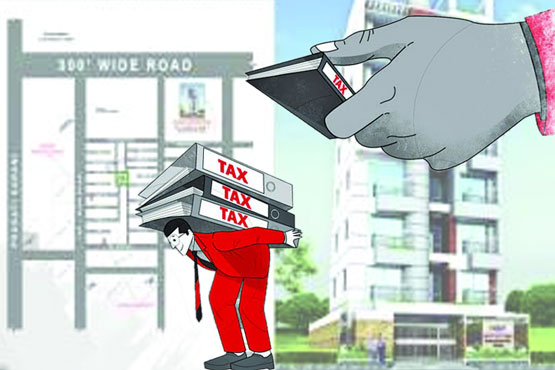
The upcoming national budget for the fiscal year 2025-26 is set to bring sweeping changes in how the government treats undisclosed money, particularly investments in the real estate sector. According to sources in the Ministry of Finance and the National Board of Revenue (NBR), the tax rate on undeclared wealth invested in flats, land, or buildings will increase up to fivefold, a move aimed at discouraging money laundering and aligning tax payments with real market values.
This new approach, which will be officially announced in the June 2 budget speech by Finance Advisor Dr. Salehuddin Ahmed, marks a significant shift in the state’s attitude toward “black money”-previously tolerated through generous amnesty schemes with minimal tax rates.
A New Fiscal Philosophy: From Tolerance to Accountability: Under the current rules, individuals holding undisclosed income-whether earned through tax evasion or unreported business activities-can legalize that money by investing it in real estate, paying as little as 3 to 6 percent tax per square meter depending on location.
But under the proposed system for FY 2025-26, that tax burden will rise dramatically, especially in affluent neighborhoods where the gap between recorded and actual market prices is stark. According to sources, the tax rate could rise by three to five times, depending on the location and nature of the investment:
In elite areas of Dhaka such as Gulshan, Banani, Dhanmondi, Tejgaon, and Motijheel, current tax rates on flats and houses stand at Tk 6,000 per square meter, while land is taxed at Tk 15,000 per square meter.
These figures may increase up to five times, resulting in potential tax obligations of Tk 30,000 per square meter for flats and Tk 75,000 for land in these zones.
“This is not just a fiscal policy-it’s a moral signal,” a senior NBR official told Daily Industry. “We want to discourage the culture of undisclosed income, particularly its flow into luxury real estate, which distorts both the housing market and revenue system.”
No More “Easy Exemptions”: The upcoming budget will continue to allow the legalization of undisclosed income, but under tighter rules and limited scopes. The NBR has stated that this privilege will be confined strictly to real estate purchases-buildings, houses, flats, floor space, and land.
However, this time, the shield of immunity long enjoyed by investors of black money will be lifted. Any relevant government agency, including the NBR and Anti-Corruption Commission (ACC), will be permitted to question the source of funds used in such purchases.
This means the days of automatic legal acceptance for money “whitened” through minimal tax payments may be coming to an end. The NBR is also considering moving from per square meter taxation to per square foot, a shift that could make evasion harder by aligning more closely with actual property valuations.
A Blow to Real Estate: While the government frames the change as a crackdown on illegal income and an effort to bring transparency to property markets, many within the real estate industry fear a severe impact on sales and development activity.
Liaquat Ali Bhuiyan, Senior Vice President of the Real Estate and Housing Association of Bangladesh (REHAB), expressed deep concern:”The condition of this sector is already very fragile. If taxes are increased and conditions are tightened, then the housing sector will completely collapse. Then no one will want to buy a flat anymore.”
Bhuiyan pointed out that real estate depends heavily on private investment, much of which historically includes unaccounted money. Strangling this pipeline could choke off demand, especially in high-end markets.
The Numbers: Why the Increase: Government officials and analysts argue that the current tax rates on undisclosed investments are unreasonably low. A Center for Policy Dialogue (CPD) analysis found that the actual effective tax rate on black money invested in real estate was just 2.38 percent of the market value-far below normal income or capital gains tax rates.Even with a fivefold increase, the effective tax rate would only rise to around 10 percent, still seen as a light burden given the illegality of the original funds.
“Increasing the rate is a step in the right direction,” a senior tax policy analyst noted. “But ultimately, the government needs to rethink whether such money should be allowed into the formal economy at all.”
Past Trends in Legalizing Undisclosed Money: Historically, the Bangladeshi government has repeatedly allowed individuals to legalize undisclosed money by paying nominal taxes:
In the 2022-23 fiscal year, around Tk 20,000 crore in undisclosed income was declared and legalized under the scheme, a significant portion of which flowed into the housing sector.
For the current 2023-24 fiscal year, neither the NBR nor REHAB has released detailed data, but officials acknowledge that the flow has likely continued quietly, aided by weak oversight.
These recurring amnesty programs have been politically controversial. Critics argue that they reward tax cheats, demoralize honest taxpayers, and distort investment incentives. Proponents counter that it allows idle capital to enter productive use, such as housing, construction, and employment.
Future of the Policy: A Slow Exit: According to NBR sources, the long-term goal is to phase out the practice altogether. The current government, under interim leadership, has already eliminated several such investment loopholes. Even the limited opportunity being allowed in FY 2025-26 is meant to be discouraging, rather than promotional.
“This year’s policy is designed to be unattractive,” said a senior NBR official. “We want to send a message that undeclared money is no longer welcome. Even if we allow it under certain conditions, we will make sure it’s no longer easy or profitable.”
The upcoming budget will also include stiffer penalties for those caught attempting to hide assets or evade taxes. Tax officials will be empowered to impose heavier fines and open investigations without needing special approval in cases where disproportionate asset growth is detected.
A Political and Economic Balancing Act: The proposed tax changes also reflect the broader objectives of the interim government led by Professor Dr. Muhammad Yunus, which is focused on macroeconomic stability, inflation control, and fiscal responsibility.
As Dr. Yunus seeks to stabilize the economy following the political transition of mid-2024, the government faces a delicate balancing act-curbing corruption and illegal wealth flows without triggering economic contraction in vulnerable sectors like real estate.
The June 2 budget announcement will be closely watched by investors, developers, and economists alike, as it signals the first major policy stance of the interim administration on the thorny issue of black money and its place in Bangladesh’s financial system.
Conclusion: A Turning Point: The move to significantly increase the tax burden on investments made with undisclosed income may mark a turning point in Bangladesh’s fiscal and governance policy. By making such investments more expensive, riskier, and subject to scrutiny, the government hopes to discourage future non-compliance and encourage formal economic activity.
Whether this new approach will succeed in both boosting revenue and cleaning up the real estate sector-without triggering a deeper slowdown-remains to be seen. What is clear, however, is that the era of tax amnesty without accountability is coming to an end.As one senior official put it, “We can no longer afford to trade short-term revenue for long-term erosion of trust in our tax system.”