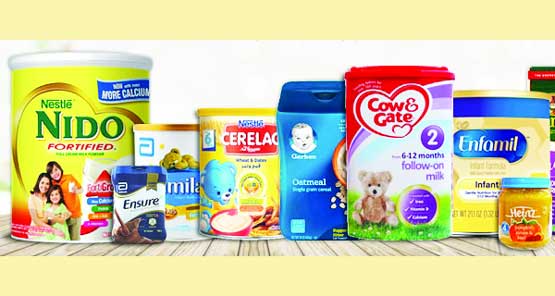
The price of baby food in Bangladesh has surged to alarming levels, with powdered milk and nutritional supplements witnessing hikes of Tk 140 to Tk 800 per box in just six months. Parents are struggling to ensure proper nutrition for their children as multinational companies dominate the market and government monitoring remains weak. For families already grappling with inflation, this relentless rise in baby food prices has added another unbearable burden, sparking concerns of long-term malnutrition among children. A Market Out of Control: A recent survey of retail outlets in Dhaka revealed steep hikes in the prices of major baby food brands: Horlicks (500 gm) - increased from Tk 500 in November to Tk 640 now (up Tk 140). Lactogen - selling at Tk 4,000 per box. Nido Three Plus - up to Tk 5,300 per box. Cerelac Fruits & Honey - rose from Tk 1,950 to Tk 2,100. Nido One Plus - selling at Tk 5,100 per box. Aptamil One - now Tk 3,300 per box.
Cow & Gate - increased by Tk 800 per box in just six months. While premium powdered milk brands like Dano and Marks have remained stable, the hikes in other products have severely hit middle- and lower-income families. This is not the first time. Baby food prices have been climbing almost every year,” said a shopkeeper at Gulshan DNCC market. “But this time, the rise has been unprecedented and very fast.” Multinational Companies Dominate: According to wholesale traders, multinational companies from the USA, Spain, Iran, and India dominate Bangladesh’s baby food market. Importers and distributors largely set the prices, which then trickle down to retail outlets with little resistance from regulators.
Rahim Uddin, cashier of Merima Tahi Enterprise, said: “For six months, prices have been dictated by importers. Once they raise it, everyone follows. Since the market is controlled by a few multinationals, there is no real competition. Parents have no choice but to buy.”
Families Struggling to Cope: For middle-class families, the skyrocketing cost has become unsustainable. Nazmul Hossain, a private employee living in Mohakhali, described the hardship: “It’s impossible to run a family on my limited salary. I already borrow money every month to cover expenses. On top of that, my three-year-old needs formula food, as advised by a nutritionist. Prices have risen so much that I don’t know how to continue.”
Parents across Dhaka and other cities echoed similar frustrations, pointing out that children’s health is at stake while authorities remain passive.
Experts: Malnutrition a Looming Threat: Health experts warn that these rising prices are not just an economic issue but a major public health concern. Professor Dr. Abu Torab Md. Abdur Rahim of the Institute of Nutrition and Food Science at Dhaka University said: “For upper-income families, the rise in prices may not matter much. But for middle- and lower-income households, purchasing power has collapsed. Poverty is rising, and with it, the ability to afford nutritious food has declined sharply. This is the government’s failure.”
He cautioned that the impact of malnutrition would be long-term and damaging. “If children grow up without proper nutrition, they will face health problems for life. Malnutrition also weakens social stability, leading to conflict and inequality.”
Poverty and Nutrition Crisis Interlinked: Bangladesh has already been battling rising poverty, driven by inflation, unemployment, and political instability. With the average household spending 70 percent of income on food, families now face impossible trade-offs between basic meals and specialized nutrition for children.
According to development economists, the price hike in baby food reflects how weak regulation and dependence on imports expose households to international price volatility and opportunistic profiteering.
CAB: Government Lacks Will to Act: The Consumers Association of Bangladesh (CAB) strongly criticized the government’s inability to stabilize the baby food market. SM Nazer Hossain, Vice President of CAB, said: “The question is not whether the government can act but whether it has the will. In the past, raids were conducted, but the culprits were never punished. In some cases, those responsible for price manipulation were even rewarded by being close to political leaders. Raids have now decreased, and actions taken are rarely followed up.”
He stressed that without strict monitoring, multinational companies and local importers will continue to exploit parents.
Consumer Protection Department: Limited Powers: Officials, however, argue that their hands are tied when it comes to imported products. Abdul Jalil, Director (Joint Secretary) of the National Consumer Rights Protection Department, said: “We run regular campaigns to keep the market stable and penalize traders who exceed set prices. But under the Consumer Protection Act, we cannot intervene if import-based products are sold at high prices. If the NBR (National Board of Revenue) fixes prices for imports, we could then take action against unscrupulous traders.”
This highlights a critical gap in policy: while essential products like rice and sugar fall under government price monitoring, baby food - despite being vital for child health - remains outside enforceable control mechanisms.
A Cycle of Yearly Increases: Historical trends show that baby food prices in Bangladesh have risen almost every year for the last decade, often outpacing inflation. Market analysts say this has become a “rule” rather than an exception.
Between 2019 and 2025: Prices of formula milk brands doubled in many cases. Nutritional supplements like Horlicks went from under Tk 400 to Tk 640 per box. Popular imported brands consistently adjusted prices upward citing global supply chain disruptions, currency depreciation, and rising import costs.
Yet, experts argue that not all increases can be justified by international factors, pointing to local profiteering as a major driver.
The Currency Factor: Bangladesh’s ongoing dollar crisis has also worsened the problem. Importers claim that the cost of bringing in baby food has increased because of exchange rate fluctuations and higher tariffs.
However, consumer rights groups argue that while some price adjustments may be justified, the steep hikes seen in recent months far exceed actual cost pressures.
Parents Forced to Cut Back: For many parents, the only option has been to cut back on baby food or switch to cheaper alternatives, raising health risks. Shahana Akhter, a garment worker in Mirpur, said: “I cannot afford Aptamil or Nido anymore. I give my child normal cow’s milk, but doctors say it’s not enough. What choice do I have? My income has not increased, only prices have.” Doctors confirm that switching away from specialized nutrition at an early age can lead to deficiencies in iron, calcium, and essential vitamins.
Broader Social Impact: Nutrition experts warn that if left unchecked, this crisis could deepen Bangladesh’s malnutrition problem. Already, 36 percent of children under five are stunted, according to UNICEF. Rising prices of baby food risk reversing progress in child health achieved over the last two decades. “This is not just about a few products. It is about the nation’s future human capital,” Dr. Rahim stressed.
What Needs to Be Done: Economists and consumer advocates have suggested several measures to stabilize the baby food market: Price Control on Essentials: Extend government price-setting to imported baby food items. Transparency in Imports: Require importers to publicly disclose import costs and justify retail price hikes. Encourage Local Production: Invest in domestic production of formula milk and baby food alternatives to reduce dependence on multinationals.
Strengthen Monitoring: Increase raids, enforce penalties, and ensure cases against manipulators are followed up.
Support for Low-Income Families: Introduce subsidies or vouchers for baby food to ensure nutrition for vulnerable children.
The skyrocketing prices of baby food in Bangladesh have exposed deep flaws in market governance, consumer protection, and food security. Parents, particularly in middle- and low-income families, are being forced to make impossible choices - often at the expense of their children’s health.
Without urgent intervention, experts warn, Bangladesh risks a “nutrition epidemic” alongside its economic and political crises. For families like Nazmul Hossain’s in Mohakhali, the issue is painfully personal: “Every day I think about how to afford my child’s food. The government talks about development, but what is the use if we cannot even feed our children properly?”