Women in Bangladesh are working longer hours, contributing more to households, and entering the workforce in record numbers. Yet, they remain paid less, promoted less, and recognized least. Despite legal provisions for equal pay and growing participation, the gender wage gap, occupational bias, and unpaid domestic labor continue to expose the country’s deep-rooted inequalities.
According to the latest Labour Force Survey 2024 by the Bangladesh Bureau of Statistics (BBS), women’s participation in the labor force has risen significantly over the last decade - from 27% to nearly 39%. Out of the country’s 121.8 million working-age population, about 71.7 million are actively employed, with over 20 million women now part of the workforce.
This growth, experts say, marks undeniable progress. Yet, behind the numbers lies a stark reality: women still earn less, work longer, and receive fewer opportunities for advancement than their male counterparts.
Wage Disparity: Equal Work, Unequal Pay: Despite having a law that guarantees equal pay for equal work, enforcement remains weak. BBS data reveal that the average monthly income for male workers stands at around Tk 16,000, while female workers earn only Tk 12,600 - roughly one-fifth less than men doing the same jobs. This disparity persists across both rural and urban sectors. In agriculture, women’s labor is often labeled as “supportive,” meaning their contribution is excluded from formal income records. Even in industrial and service sectors, women in identical roles are routinely paid less.
“Women’s growing participation at ownership and management levels is a sign of social progress,” said Nasreen Fatema Awal, President of the Women Entrepreneurs Association of Bangladesh (WEAB), speaking to The Daily Industry. “But many women still face bias when it comes to evaluation, promotion, or leadership roles. To fix this, we need gender-sensitive workplaces and policy support that recognize women’s dual burden - at work and at home.”
RMG Sector: Women Power, Unequal Rewards: The ready-made garment (RMG) industry - Bangladesh’s largest export earner - remains the single biggest employer of women. However, wage inequality in the sector remains significant. Multiple studies, including one by the Anchor Research Institute (USA), found that women in RMG factories earn 22% to 30% less than their male colleagues for similar roles. Despite representing nearly 80% of the total workforce, women occupy less than 10% of managerial positions. Take Rehana Akhter, a sewing operator in Savar who has worked at the same position for six years. “I do the same work as the men here,” she said. “But I never got promoted - only small salary increases. The men get better opportunities even with less experience.”
Researchers note that the wage gap widens as women move up the ladder. Management, supervision, and quality-control jobs are mostly held by men. Many women lose out due to social pressures and the expectation that they prioritize family duties over career growth. “The gender pay gap in factories can reach up to 30%,” said Dr. Farhana Rahman, a labor economist. “Even when women have the skills, their work is undervalued - not because of productivity, but because of perception.”
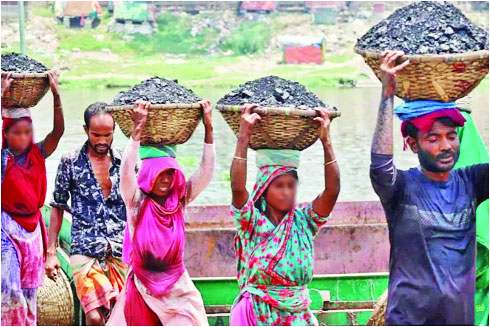
Daily Wage Work: Rural Inequality Persists: In informal sectors such as day labor and manual work, gender wage gaps are even more striking. At Burimari in Lalmonirhat and Sonahat Land Port in Kurigram, hundreds of men and women work side by side breaking stones. Yet men earn around Tk 500 per day, while women receive Tk 400 for the same workload. That Tk 100 daily gap translates into a significant loss over a month, pushing female workers further into poverty despite equal labor. “Women are treated as ‘assistants,’ not as workers,” said Amena Begum, one of the stone breakers interviewed by The Daily Industry. “But we lift, carry, and break just as much. We work the same hours.”
Educated Women Face Hidden Barriers: Higher education is not a guarantee of equality either. The BBS survey shows that 29% of women with graduate or higher degrees remain unemployed, compared to only 12% among men with the same qualifications. This means that even highly educated women are less likely to find suitable jobs - and those who do often earn less or face limited promotion opportunities. “Many women leave their jobs due to workplace harassment, inflexible hours, or a lack of childcare support,” said Dr. Rowshan Ara, a professor of economics at Dhaka University. “We’re losing a large portion of our skilled female labor force because institutions are not adapting to women’s needs.”
The Invisible Economy of Unpaid Care Work: One of the most overlooked aspects of women’s contribution to the economy is unpaid care work - household chores, cooking, cleaning, and caring for children and the elderly. According to the Unpaid Household and Care Work Survey 2024, women in Bangladesh spend an average of 6 hours and 40 minutes a day on unpaid domestic work. Men, by contrast, spend just 2 hours and 20 minutes. If the economic value of this unpaid labor were calculated, women’s contribution could account for nearly one-fourth of Bangladesh’s total GDP, the survey estimated. Yet, this labor receives neither recognition nor compensation. “In most families, women’s work is still viewed as secondary or ‘helping income,’” said Dr. Fahmida Khatun, Executive Director of the Centre for Policy Dialogue (CPD). “Their household work - cooking, caregiving, managing homes - remains invisible in national statistics. But if we value it properly, policymakers could design more realistic budgets for social services, healthcare, and employment.”
Legal Protection Exists - But Enforcement Lags: Bangladesh has laws guaranteeing equal pay for equal work and prohibiting workplace discrimination. But according to labor rights activists, enforcement is inconsistent. The majority of women work in the informal sector, where legal protection is weakest. “Formal policies exist, but implementation is poor,” said Sharmin S. Murshid, Women and Child Affairs Adviser. “Gender disparities persist because our institutions are not gender-responsive. The BBS data can now guide us in shaping fairer, more inclusive national policies.” She added, “We, as women, are not seeking privilege - we’re asking for equal respect and recognition from society and our partners. It won’t come easily, but data and facts will help us make the case for equality.”
South Asia’s Struggle with Gendered Labor: Bangladesh’s experience reflects a broader South Asian trend. Across developing nations, women’s labor participation remains low, and most work is informal or underpaid. According to the World Bank, female participation in labor across developing economies is marked by high unemployment, gender pay gaps, and occupational segregation - where women are concentrated in low-paying or insecure jobs. Bangladesh, despite its RMG-driven progress, is no exception. Still, experts see a way forward. “Bangladesh has shown strong progress in bringing women into the workforce,” said Dr. Hossain Zillur Rahman, Executive Chairman of the Power and Participation Research Centre (PPRC). “The challenge now is to ensure that participation translates into parity - in pay, promotion, and policy.”
Toward a Gender-Responsive Economy: Economists and policymakers are calling for structural reforms that address wage discrimination, promote safe workplaces, and recognize unpaid labor as part of the national economy.
Key recommendations include: Strict enforcement of the Equal Pay Act. Incentives for companies to appoint women in management roles. Affordable childcare facilities in workplaces. Training and re-skilling programs for educated but unemployed women.
Inclusion of unpaid care work in national accounting systems. Without such measures, Bangladesh risks widening its gender inequality despite economic growth.
Recognition Beyond Numbers: The BBS report reveals a paradox: as more women join the workforce, their economic recognition remains stagnant. Whether in factories, offices, or households, women continue to carry an invisible burden - working equally hard but earning less, being evaluated less, and respected less. “Gender equality in labor is not only a women’s issue; it’s an economic necessity,” said Dr. Fahmida Khatun. “A fair economy cannot thrive when half of its workforce remains undervalued.”Until equality in pay and dignity becomes a lived reality, Bangladesh’s journey toward inclusive development will remain incomplete.