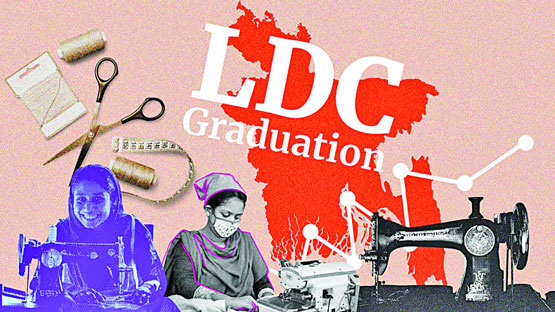
Bangladesh is set to graduate from the Least Developed Country (LDC) category on November 24, 2026, marking a significant milestone in the nation’s economic development. However, trade and industry experts warn that the country’s export sector may face serious challenges unless urgent steps are taken to diversify products and explore new markets. Currently, as an LDC, Bangladesh enjoys preferential access to global markets, including duty-free trade, reduced tariffs, and other incentives. These benefits provide a competitive edge to Bangladeshi products, especially in key markets such as the European Union, Canada, and Australia. However, these advantages will largely disappear after graduation, exposing the country’s exports to full market competition.
“Bangladesh’s graduation from the LDC category is a moment of pride, but it also poses significant challenges for the export sector,” said Abu Ahmed, Chairman of the Investment Corporation of Bangladesh (ICB). “Currently, our export basket is heavily concentrated in readymade garments. Without diversification of products and markets, our trade earnings could face stagnation or even decline.” Business leaders and economists have emphasized the need for a cautious and phased approach. Many have suggested a three-year postponement of LDC graduation to allow the government and private sector to strengthen institutional, financial, and administrative preparedness. “Bangladesh needs policy support both domestically and internationally to manage
this transition,” said an official at the Export Promotion Bureau (EPB). “Without such support, the export sector, which contributes over 80% of foreign exchange earnings, could face severe difficulties.”
Despite repeated government promises over the past two decades, initiatives to diversify export products have largely failed. About 17 years ago, the EPB launched the ‘One District, One Product’ program, aimed at identifying specific products in each district for large-scale production and export. While pilot initiatives were undertaken in select districts, the program failed to achieve significant results and was eventually discontinued.
Last year, the EPB attempted a new approach under the ‘One Village, One Product’ initiative to boost product diversification at the micro level. However, the program lost momentum just three months after its launch due to administrative and political changes. “The idea was promising, but follow-through was weak,” said a senior EPB official. “Effective policy implementation and consistent government support are critical to achieving diversification.”
Currently, Bangladesh exports around 125 products, but the readymade garment sector and related items account for 84% of total export earnings. The next ten top export products together contribute about 8%, while the remaining products generate negligible revenue. Experts warn that such a narrow export base leaves the country vulnerable to global market fluctuations and trade disruptions.
“Bangladesh’s export basket is still heavily dependent on garments,” said Syed Sultan Uddin Ahmed, former chairman of the Labour Reform Commission. “There are very few competitive products outside the garment sector that can be produced on a large scale. Without diversifying both products and markets, it will be extremely difficult to sustain export growth in the post-LDC era.”
The challenge extends beyond product diversity to market diversification. While Bangladesh has established strong trade relations in Europe, North America, and parts of Asia, it has limited presence in emerging markets in Latin America, Africa, and Southeast Asia. Experts suggest that cash incentives alone will not be enough to expand into these markets. Instead, Bangladesh must strengthen its trade diplomacy, reduce trade barriers, and negotiate free trade agreements to improve market access.
Abu Ahmed of ICB stressed that structural reforms in customs, tariffs, and trade logistics are critical. “Our current protective tariff structures act as a barrier to export growth. We need to simplify customs procedures, reduce delays, and align policy incentives with global standards to ensure competitiveness. Otherwise, we risk losing market share after LDC graduation,” he said.
Industry leaders echo these concerns. The Bangladesh Garment Manufacturers and Exporters Association (BGMEA) has repeatedly called for a strategic plan to diversify exports beyond garments, including high-value goods such as leather, jute, frozen seafood, pharmaceuticals, and information technology products. “Global buyers are increasingly looking for diverse sourcing options,” said a BGMEA spokesperson. “If we fail to diversify, Bangladesh will remain dependent on a single sector, which is risky in a post-LDC trade environment.”
Experts also warn that effective diversification requires coordination between the public and private sectors. Policy support, investment in infrastructure, skill development, and access to finance are essential to support new export products and industries. “The government must work closely with exporters to identify high-potential products and markets, provide technical assistance, and ensure smooth access to credit,” said Abu Ahmed.
Some analysts argue that graduation offers an opportunity to move up the global value chain if handled strategically. “Graduation is not just a challenge; it is an opportunity to modernize our export strategy, focus on high-quality and high-value products, and enter new markets,” said Dr. Imran Hossain, a trade policy analyst. “But time is short, and preparation must be immediate and comprehensive.”
Bangladesh’s policymakers are aware of the urgency. Initiatives such as the upcoming trade missions to Latin America and Africa, as well as pilot projects under ‘One Village, One Product,’ signal intent. However, experts caution that without sustained follow-through, past patterns of delayed and half-hearted initiatives may repeat.
As Bangladesh prepares to graduate from the LDC category, the consensus among economists and trade specialists is clear: the country must diversify both its export products and markets, streamline trade processes, and strengthen institutional support. Only then can Bangladesh ensure sustainable export growth and competitiveness in a post-LDC world. “Graduation is a milestone, but it should not be the beginning of export vulnerability,” said Abu Ahmed. “We need to act decisively now to secure Bangladesh’s trade future.”