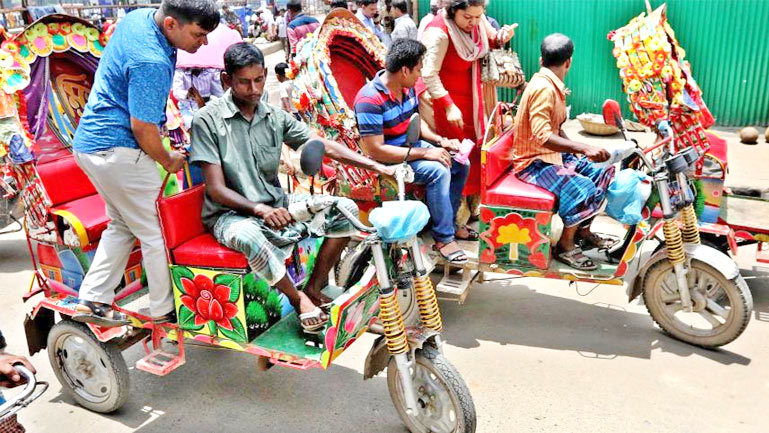
Battery-powered rickshaws are an inevitable reality in urban and peri-urban life in Bangladesh today. Their presence is now a daily sight on the busy roads of Dhaka, district towns, and even paved roads in rural areas. This vehicle did not emerge suddenly; rather, it has emerged as a spontaneous solution in the context of energy crisis, rising fuel prices, pressure on transportation costs, and employment constraints. On the one hand, it is an affordable and easily available alternative, on the other hand, it has created a complex challenge from a legal, safety, infrastructure, and environmental perspective. As a result, the question arises-how can this vehicle be made safe, modern, and legally legal and included in a sustainable system?
The reality of the energy crisis and alternatives. The global energy crisis is no longer just an economic issue, but a long-term structural reality. Fluctuations in international oil prices, supply chain uncertainties, and geopolitical instability are putting severe pressure on developing countries. Bangladesh is not immune to these impacts. Over-reliance on diesel and petrol-powered vehicles is adding to the burden on the economy.
In this context, battery-powered rickshaws have emerged as an alternative. They use electricity instead of fuel, which is seemingly environmentally friendly and economically viable. They have become an important source of livelihood, especially for low-income people. But uncontrolled expansion has turned them into a policy crisis.
Possibilities, problems and the need for transformation
1. Economic opportunity and social importance
Battery-powered rickshaws are ensuring the livelihood of thousands of people. Poor and lower-middle class people coming to the city are able to buy a rickshaw with little capital and start earning. It is working as a social safety net for them.
It is a quick source of employment for rural migrants. It has created a relatively stable income opportunity instead of daily wages or irregular income. As a result, if it is completely stopped, it could create a massive social crisis.
2. Role in addressing the energy crisis
Battery-powered rickshaws can be an effective alternative during times of fuel shortage. They reduce dependence on petrol or diesel and play an important role in short-distance urban travel.
However, an important aspect here is the source of electricity generation. If electricity comes from fossil fuels, its environmental benefits are limited. Therefore, to make this vehicle sustainable, the use of renewable fuels must be increased.
3. Security and road system crisis
The rapid spread of battery-powered rickshaws has created a major challenge in road safety. Many vehicles are plying illegally, with no standards. Lack of training among drivers and a tendency to disobey traffic laws increase the risk of accidents.
In addition, traffic congestion is increasing due to the lack of coordination of these vehicles with the city's road system. The lack of designated lanes, failure to adhere to speed limits, and disregard for traffic rules have exacerbated these problems.
4. Environmental aspects and challenges
Although battery-powered rickshaws do not directly emit carbon, their environmental impact is not entirely positive. Battery disposal is a major problem. Lead-acid batteries, if not recycled properly, pose a serious risk to the environment and public health.
In addition, the source of electricity generation and the efficiency of the charging system must also be taken into consideration. Therefore, an overall policy is needed to make it environmentally friendly.
5. Things to do for a modern and safe system
To make battery-powered rickshaws sustainable, safe, and legally valid, it is essential to take some important steps:
A. Registration and licensing system
First, all battery-powered rickshaws should be brought under registration. Licenses should be issued through a specific authority so that illegal vehicles can be identified. This will both generate revenue for the government and establish control.
B. Driver training and qualification
Mandatory training for drivers should be introduced. Providing traffic law, safety, and behavioral training will reduce the risk of accidents. In addition, a specific age limit and health criteria should be set.
C. Setting speed limits and design standards
A specific speed limit should be set for rickshaws. In addition, technical standards (such as brakes, lights, horns) should be made mandatory. Using advanced battery technology will reduce risks and increase efficiency.
D. Determination of specific routes and lanes
Urban planning should designate specific routes or lanes for these vehicles. This will reduce pressure on the traffic system and increase road safety. Access to major roads can be restricted.
E. Battery management and environmental protection
An effective system for battery recycling must be developed. Used batteries must be collected and safely recycled. This will reduce environmental pollution and ensure sustainable development.
F. Development of electricity infrastructure
There are currently over six million battery-powered rickshaws and easy bikes operating across the country. An average of 750 to 800 megawatts (MW) of electricity is used daily from the national grid to charge these vehicles.
Daily electricity consumption: Approximately 24,000 megawatt-hours (MWh) or 24 million units of electricity are required daily to charge all battery-powered rickshaws and easy bikes across the country.
Monthly Total Cost: The total electricity consumption in this sector across the country per month is about 720 gigawatt-hours (GWh) or 720 million units.
Monetary Value: Considering the average price of commercial electricity, the market value of this huge amount of electricity across the country per month is about 750 to 900 crore taka.
Total number of rickshaws 6 million+ (nationwide)
Daily electricity demand 750 - 800 MW
Daily charge of a rickshaw 6 - 9 units
Monthly total unit cost 72 crore units (approx.).
Illegal charging: Studies have shown that a large portion of charging (about 90%) is done through illegal electricity connections, which is causing a revenue loss of about 4,000 crore taka to the government annually. Impact on demand: This large amount of electricity is usually charged at night (off-peak hours), which in many cases increases the pressure on local transformers and causes load shedding or outages.
Charging stations need to be made safe and regulated. Efficiency in electricity use needs to be increased and the use of renewable energy needs to be encouraged.
Case Study: Life in Dhaka's Karail Slum
The life of Rafiqul Islam, a battery-powered rickshaw puller in Dhaka's Karail slum, is a reflection of this reality. He was previously a daily wage laborer. His income was irregular. Now, by driving a rickshaw, he can earn a fixed monthly income, which is important for his family's sustenance.
"Without this rickshaw, it would have been difficult for me to run my family," he says. However, he also admits that there are times when there are police hassles and the fear of accidents.
This case study shows us that this vehicle is not just transportation, but an economic safety net. So it is important to bring it into a framework rather than shutting it down.
Coordination of control and transformation
Battery-powered rickshaws have become an important part of urban life in Bangladesh. They are a potential alternative in the context of the energy crisis, but at the same time they pose policy and structural challenges.
What is needed now is an integrated policy-one that considers security, the environment, the economy, and social realities together. Not a complete ban, but rather a transformation into a legal and effective system through regulation and modernization.
With a combination of safe roads, a fair traffic system, and environmentally friendly technology, battery-powered rickshaws can become part of a sustainable urban transport system. It is not just a vehicle, but a complex but important chapter in Bangladesh's development journey.
Author: Journalist, Columnist