Australia is a stable, culturally diverse, and wealthy nation, uniquely acting as both the world's sixth-largest country and the only one governing an entire continent. Located in the Southern Hemisphere, it features diverse landscapes, including arid deserts ("the outback") and tropical rainforests. Known for endemic wildlife like kangaroos and koalas, it boasts high urban-density coastal cities like Sydney and Melbourne, with a population concentrated in the southeast. The European Union (EU) is a unique economic and political union of 27 democratic European nations established in 1993, acting as a single market to ensure the free movement of goods, services, capital, and people. It fosters peace, stability, and economic prosperity, with most members sharing the Euro currency and promoting shared values like human rights.
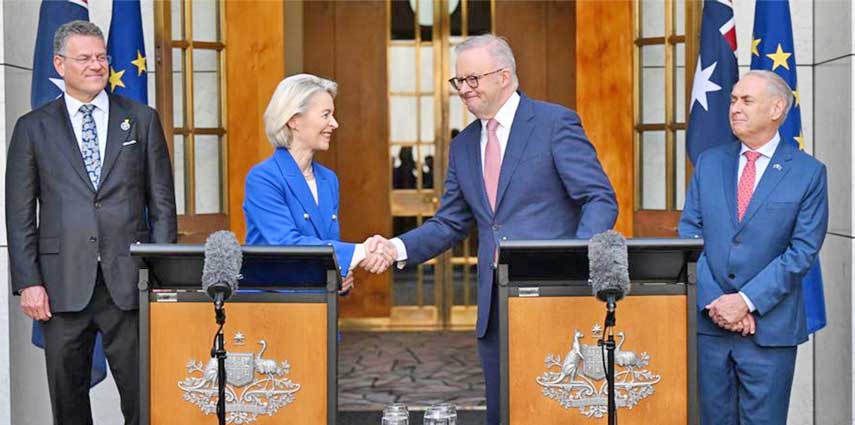
The European Union and Australia recently reached a long-awaited free-trade deal while also agreeing to boost defense cooperation and access to crucial rare-earth minerals in the face of global uncertainty over energy & trade. The announcement of the deal came after eight years of negotiations, during EU chief Ursula von der Leyen's visit to Australia, as the 27-nation bloc and the import-reliant nation navigate renewed energy vulnerability sparked by the war in the Middle East.
The trade deal between the European Union and Australia would have several important effects on the global economy. First, it would boost global trade by reducing tariffs and barriers. European and Australian exports-such as agricultural goods, machinery, and services-would become cheaper and more competitive. This could increase overall trade volume and strengthen supply chains across continents. Second, it would promote economic growth. Both economies would likely experience higher GDP growth due to increased market access, investment flows, and business expansion.
This could also create jobs and encourage innovation, especially in sectors like renewable energy, technology, and education. Third, it would reshape global trade patterns. Countries outside the agreement might face stronger competition, especially in Asia-Pacific markets. Some developing countries could lose market share if they cannot compete with improved EU-Australia trade efficiency. Fourth, it could strengthen geopolitical ties. Closer economic cooperation may enhance political alignment on global issues such as climate change, digital trade, and security. It would encourage further trade agreements. A successful deal could motivate other regions to pursue similar partnerships, accelerating globalization.
The recent free trade agreement between the European Union (EU) and Australia marks a significant shift in global agricultural trade, particularly in the movement of Australian beef into European markets. Under this landmark deal, more Australian beef is set to head to Europe, reflecting both economic opportunity and ongoing tensions within the agricultural sector.
One of the central features of the agreement is the expansion of tariff-rate quotas for Australian beef exports to the EU. Over the next decade, the quota is expected to rise significantly, allowing tens of thousands of tons of Australian beef to enter Europe at reduced or zero tariffs. This represents a major development, as access to the EU's large and high-value consumer market has long been a key objective for Australian farmers. The increased flow of Australian beef into Europe offers several economic benefits. For Australia, it opens up a lucrative export destination, potentially boosting rural incomes and strengthening the agricultural sector. The broader trade deal is projected to add around A$10 billion annually to Australia's economy, with agriculture playing an important role. For European consumers, the agreement could lead to greater variety and potentially lower prices due to increased competition and supply. However, the deal is not without controversy.
European farmers have expressed concerns about competition from imported beef, fearing that cheaper Australian products could undercut local producers.
To address these concerns, the EU has implemented safeguards and limited quotas, ensuring that imports remain a small share of total consumption-estimated at around 0.5% of EU beef consumption. These protections highlight the EU's attempt to balance market liberalization with the protection of its domestic agricultural sector.
On the Australian side, reactions have also been mixed. While the deal expands market access, many industry representatives argue that the quotas are still too restrictive and fall short of expectations. Some critics have described the agreement as a missed opportunity, noting that the final beef quotas are lower than what Australia had initially sought. Beyond agriculture, the deal reflects broader strategic goals. Both the EU and Australia aim to diversify trade partnerships and reduce dependence on dominant global players such as China. The agreement also strengthens cooperation in areas like critical minerals, energy, and services, making it a comprehensive economic partnership. The increase in Australian beef exports to Europe under the new EU trade deal represents both progress and compromise.
While it enhances trade opportunities and economic growth, it also underscores the complexities of balancing global trade liberalization with domestic interests. The long-term success of the agreement will depend on how effectively both sides manage these competing priorities.
Overall, such a deal would likely have a positive but uneven impact-boosting growth and trade while increasing competition worldwide.
The recent trade agreement between the European Union and Australia can serve as a strong example for other nations seeking to strengthen economic cooperation. In a time of rising protectionism and global uncertainty, this deal highlights the importance of mutual trust, negotiation, and long-term vision in international trade. One key lesson is the balance between opportunity and protection.
While the agreement opens markets-such as increased Australian beef exports-it also includes safeguards to protect domestic industries. This shows that trade deals do not have to harm local producers if carefully structured. Additionally, the deal reflects the value of diversification. Both partners aim to reduce reliance on limited markets and build more resilient supply chains. Countries in regions like Asia and Africa can learn from this approach to expand their trade networks. The EU-Australia agreement demonstrates that fair, strategic, and balanced trade partnerships can promote global economic growth and cooperation.
Md. Muzibur Rahman, M.S.S. (Economics), writer, columnist & freelancer, can be reached at: E-mail: creativewritermuzibur@gmail.com