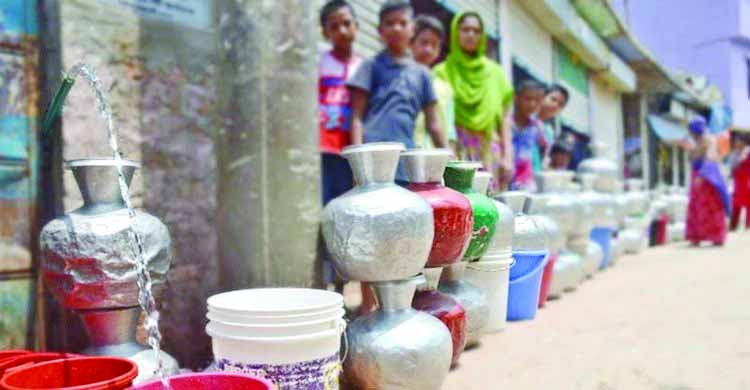
The groundwater level beneath Dhaka is steadily declining due to heavy reliance on deep tube wells, raising serious concerns among water experts about the city's long-term water security.
With daily water demand rising sharply in the capital, groundwater remains the primary source of supply. Hundreds of deep tube wells operate continuously to meet consumption needs, but this heavy extraction is causing the water table to drop year after year. Experts warn that if the current trend continues, Dhaka could face a severe water crisis in the future. According to sector estimates, the groundwater level in the city is falling by around two to three meters annually. This means water that was once accessible at relatively shallow depths now requires deeper and costlier extraction.
“The overdependence on groundwater extraction without adequate natural recharge is creating a dangerous imbalance,” experts said in a report quoted by The Daily Industry. They added that the city's natural replenishment system is being disrupted as urban expansion reduces open land and limits rainwater infiltration.
Rising Dependence on Groundwater: Despite being surrounded by rivers, Dhaka cannot rely on surface water due to severe pollution in nearby rivers. As a result, the city has been forced to depend on distant sources such as the Padma and Meghna rivers.
Major water treatment projects, including the Saidabad Water Treatment Plant and the Gandharbpur project, have been launched to increase surface water supply. However, these initiatives are still insufficient compared to the rapidly growing demand of the megacity.
Officials estimate that Dhaka's daily water demand is around 31.5 billion litres, while supply stands at approximately 29.8 billion litres. A significant portion of this supply still comes from more than a thousand deep tube wells.
Environmental and Economic Pressure: Water extraction from deep underground sources requires increasing amounts of electricity, maintenance, and infrastructure support. As a result, operational costs are rising, contributing to recent adjustments in water pricing.
“This is no longer just an environmental issue; it is becoming an economic burden as well,” The Daily Industry quoted stakeholders as saying.
Residents in several areas have also reported inconsistent water quality, including foul smell, contamination, and low water pressure, further adding to public dissatisfaction.
Experts Warn of Long-Term Risks: River and environmental experts argue that simply increasing the number of tube wells is not a sustainable solution. They stress the need for a comprehensive urban water management strategy that prioritizes surface water treatment and alternative supply sources.
Mohammad Aminur Rasul Babul, Fellow at the River and Delta Research Centre, told The Daily Industry that there is a lack of coordination between urban planning, population growth, and water management. “Without integrated planning that considers future population pressure, the crisis will only worsen,” he warned.
Environmental expert Professor Dr. Ahmad Kamruzzaman Majumder highlighted that destruction of water bodies, filling of ponds, encroachment of canals, and pollution have further reduced groundwater recharge capacity. “When natural reservoirs shrink, groundwater replenishment is automatically reduced,” he said.
Water experts also note that the rapid loss of open spaces in Dhaka has significantly reduced rainwater absorption into the soil. As the city becomes increasingly concrete-covered, natural recharge systems are weakening.
Professor Ainun Nishat warned that groundwater is being extracted far beyond safe limits. “If alternative sources are not developed immediately, the situation will become much more difficult,” he cautioned.
Growing Seasonal Pressure: During the summer season, rising temperatures significantly increase water consumption, placing additional pressure on the supply system. At present, around 60 to 71 percent of Dhaka's total water supply still depends on groundwater extracted through deep tube wells. Experts say this overdependence raises serious concerns about the city's future water security, especially as demand continues to rise with population growth and urban expansion.