Biman Bangladesh Airlines, the state-owned flag carrier, has once again declared itself a “profitable organization,” posting a net profit of Tk 282 crore for the fiscal year 2023-24. However, this financial report may not reflect the full picture, as the airline continues to grapple with a massive backlog of unpaid debts to multiple organizations, including Padma Oil, the country’s sole supplier of jet fuel, and the Civil Aviation Authority (CAA). Despite its declared profitability, Biman’s financial struggles are far from over.
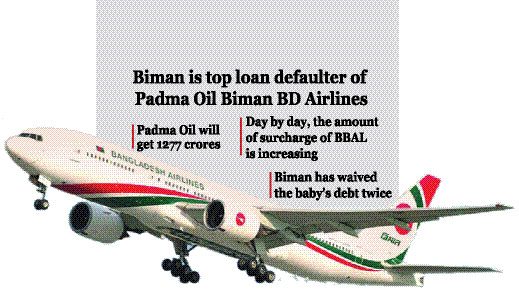
Padma Oil, a subsidiary of Bangladesh Petroleum Corporation (BPC), has revealed that Biman owes a staggering Tk 1,277 crore for fuel supplies. The debt has been accumulating for years, with Biman being one of Padma Oil’s largest customers. Yet, Biman continues to report profits on paper, without addressing these mounting arrears. To make matters worse, the Civil Aviation Authority of Bangladesh (CAA) is also seeking around Tk 5,000 crore in outstanding payments from the airline, including both aeronautical and non-aeronautical dues.
The financial report approved by Biman on December 18 claims the airline earned Tk 10,575 crore in total revenue for FY 2023-24. However, the growing debt load reveals a different reality. While Biman’s balance sheet shows a profit, the actual financial condition of the airline raises questions about its long-term sustainability.
The debt issue dates back to the 2009-10 fiscal year, when Biman first started accumulating dues to Padma Oil. By 2020, the arrears had reached Tk 21 billion, with Biman purchasing jet fuel worth Tk 3 billion every month, yet only making partial payments of around Tk 20 billion annually. The airline’s financial troubles worsened during the COVID-19 pandemic, when it requested a waiver of the arrears, citing massive losses in the aviation sector. However, the BPC rejected this request, and instead, a long-term repayment plan was established.
Under the current arrangement, Biman has agreed to pay the arrears in monthly installments of Tk 10-15 crore, with a commitment to clear the debt by 2026-27. However, Padma Oil has warned that at the current rate of repayment, it could take up to 17 to 20 years to settle the debt in full-far longer than the airline’s promised timeline.
The Ministry of Power, Energy, and Mineral Resources has been actively involved in the negotiations between Biman and Padma Oil. Mohammad Faruk, Joint Secretary of the Ministry, confirmed that the government is pressing Biman to increase its monthly payments to speed up the debt repayment process. Currently, Biman is paying only Tk 15 to 20 crore per month. While Faruk emphasized that there is no possibility of waiving the debt, he insisted that Biman must pay off the full amount.
Despite the pressure, Biman’s reluctance to settle its dues continues to raise concerns. The airline’s financial troubles are compounded by a broader lack of transparency in how debts are managed, with many questioning whether the reported profits are a result of creative accounting rather than actual financial health.
Biman Bangladesh Airlines, the state-owned national carrier, is once again at the center of a debt crisis, this time with the Civil Aviation Authority of Bangladesh (CAA). While Biman continues to declare record profits, it is also sitting on an enormous pile of unpaid dues, totaling approximately Tk 6 billion as of late 2023. These debts, related to both aeronautical and non-aeronautical charges, have been accumulating steadily, yet Biman has shown little effort to settle them.
The dues to the CAA cover a wide range of charges, including aircraft landing fees, route navigation services, boarding bridge usage, and various ground handling services. Biman’s continued reluctance to pay these charges raises concerns about the airline’s financial management, even as it reports impressive earnings.
Biman has a long history of debt issues, with the most notable instance occurring in 2008 when the airline was burdened with around Tk 18 billion in debt. At that time, the airline sought a waiver from the Ministry of Finance, successfully getting Tk 1,216 crore of its dues waived. The remaining Tk 573 crore was paid off. Again in 2017, Biman received a massive break when the Bangladesh Investment Corporation (BIC) wrote off an outstanding debt of Tk 17 billion. However, this time, Biman is unlikely to receive any forgiveness, according to statements from key officials.
SM Lablu Rahman, BIC member (Finance), confirmed that there are no ongoing discussions regarding the waiver of Biman’s outstanding dues. He emphasized that these arrears, both from Padma Oil and the Civil Aviation Authority, are not being forgiven and that there are no current plans for any such action.
Despite the growing mountain of debt, Biman continues to report strong financial results. According to the airline’s annual report for the fiscal year 2023-24, Biman earned a record Tk 10,575 crore, a 9.5% increase from the previous year. The airline reported an operational profit of Tk 1,556 crore, although its net profit stood at Tk 282 crore after accounting for exchange losses and taxes. This marks the fourth consecutive year of profitability for Biman, a streak that began after the pandemic. In fact, Biman has posted a net profit in eight of the last 10 fiscal years, despite the ongoing financial challenges.
In addition to passenger services, Biman also saw significant growth in cargo transport. The airline handled a total of 43,044 tons of cargo, earning Tk 637 crore, which is a 60% increase from the previous year. The airline’s ground handling services were also in high demand, supporting over 6.6 million passengers on 33,297 flights for 32 foreign passenger airlines and 17 cargo carriers.