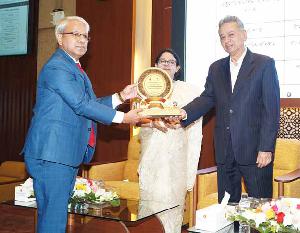
Regaining stability in Bangladesh’s banking sector is critical to restart business operations and economic activities nationwide, says Dr. Arifur Rahman, Chairman of The Premier Bank PLC, in an exclusive interview with Daily Industry yesterday at the bank’s head office in Banani.
“The banking sector has faced unprecedented challenges in recent years, particularly due to the historic high default loans amounting to Tk 6.44 trillion. This created instability that affected trade, investment, and public confidence. However, the situation is gradually improving,” Dr. Rahman added.
According to Dr. Rahman, the path to recovery has been complex but promising. “Banks are now taking strong measures to overcome financial challenges. Transparent leadership changes at the top management level in many banks have helped restore credibility, improve governance, and stabilize operations. This has allowed several institutions to recover from past weaknesses and regain their operational efficiency.”
Internal Policy Reforms and Strategic Measures: Talking about The Premier Bank’s initiatives, Dr. Rahman highlighted several internal policy reforms. “We are focusing on three key areas: deposit mobilization, responsible loan disbursement, and effective recovery measures. By strengthening these core activities, we aim to ensure that our bank contributes positively to the broader financial ecosystem while safeguarding the interests of depositors and investors,” he said.
He emphasized that deposit mobilization is central to regaining confidence in the banking system. “Encouraging customers to maintain and increase deposits provides us with the liquidity necessary to meet loan demands and support economic activities. We have introduced new deposit schemes and enhanced our digital banking infrastructure to make banking services more convenient and reliable for our clients,” Dr. Rahman added.
Loan management has also been a priority. The Premier Bank has implemented stricter credit appraisal processes to reduce the risk of defaults. “We are ensuring that loans are disbursed to viable businesses and entrepreneurs who demonstrate repayment capacity. At the same time, we have strengthened our recovery systems to retrieve overdue amounts efficiently, without harming client relationships,” he explained.
Challenges and Opportunities: While Dr. Rahman is optimistic about the sector’s recovery, he acknowledged the remaining challenges. “The legacy of high defaulted loans and previous governance gaps cannot be undone overnight. Banks must continue to focus on transparency, compliance, and prudent risk management. Only then can the sector regain public confidence fully and play its role in driving economic growth,” he noted.
He also pointed to opportunities arising from this transitional period. “Banks that successfully navigate these challenges will emerge stronger, more resilient, and more capable of supporting Bangladesh’s rapidly growing economy. There is significant potential in sectors such as manufacturing, exports, agriculture, and SMEs, which require financial backing to grow. By targeting these areas responsibly, banks can stimulate employment and economic development.”
Commitment to National Economic Growth: Dr. Rahman expressed The Premier Bank’s strong commitment to contributing to Bangladesh’s economic revival. “Our goal is not just to restore financial stability within our bank but also to play a role in boosting trade, business, and investment nationwide. A stable banking sector is essential for facilitating credit, supporting infrastructure projects, and enabling businesses to operate smoothly,” he said.
He highlighted several initiatives that The Premier Bank has undertaken in recent months to support local businesses. “We have increased our focus on SME lending, recognizing the sector’s vital contribution to employment and economic growth. We are also expanding our trade finance operations to assist exporters and importers, ensuring that the flow of goods and services remains uninterrupted.”
Digitalization and Customer-Centric Approach: In addition to financial reforms, Dr. Rahman emphasized the bank’s commitment to digitalization and a customer-centric approach. “We have invested in modern banking technologies, including mobile and internet banking platforms, real-time transaction systems, and advanced risk monitoring tools. This not only improves efficiency but also builds trust among our clients,” he said.
“Customer trust is the backbone of a bank’s stability. By maintaining transparency in operations, offering competitive services, and responding promptly to customer needs, we strengthen our credibility. This approach is essential to support both small-scale entrepreneurs and large corporate clients,” he added.
Governance and Leadership Changes: Dr. Rahman attributed a significant portion of the sector’s ongoing recovery to governance reforms at the top management level. “Many banks faced issues due to opaque decision-making and lack of accountability in the past. By introducing capable leadership and promoting transparency, we have instilled confidence both internally and externally. At The Premier Bank, these changes have allowed us to streamline decision-making, improve monitoring, and enhance overall efficiency.”
He stressed that these reforms are not merely cosmetic but represent a fundamental shift in the way banks operate. “Good governance is not optional; it is a prerequisite for sustainable banking operations. We aim to set an example by ensuring ethical practices, transparency in reporting, and responsible management of public funds,” Dr. Rahman noted.
Regulatory Support and Collaboration: Dr. Rahman acknowledged the role of Bangladesh Bank and regulatory authorities in supporting the sector’s recovery. “The central bank’s proactive policies, including monitoring high default loans, issuing guidelines for asset quality improvement, and encouraging responsible lending, have been instrumental. Collaboration between banks and regulators ensures that corrective measures are implemented effectively,” he said.
He further stressed that policy stability is essential for economic confidence. “Businesses and investors need assurance that financial institutions are reliable, well-capitalized, and capable of supporting long-term projects. This is why regulatory oversight, combined with internal bank reforms, creates a conducive environment for economic recovery,” he added.
Optimism for Recovery:
Despite the sector’s historic challenges, Dr. Rahman expressed optimism about the road ahead. “The Premier Bank has made significant progress in regaining stability, improving internal controls, and supporting customers. While there is still work to do, we are confident that with consistent policies, ethical leadership, and a focus on risk management, the banking sector will return to full strength,” he said.
He also highlighted the potential impact on the broader economy. “Stable banks mean businesses can access credit, entrepreneurs can expand operations, and consumers can feel confident in their savings. In turn, this supports overall economic activity, job creation, and national development. Our responsibility is to ensure that the banking sector plays its role effectively in this ecosystem,” Dr. Rahman concluded.
The interview with Dr. Arifur Rahman underscores the critical link between banking sector stability and national economic revival. With high defaulted loans historically threatening confidence, reforms in governance, internal policy, and risk management are essential. The Premier Bank’s efforts in deposit mobilization, loan disbursement, recovery, digitalization, and customer-focused services reflect a commitment to restoring credibility and contributing to Bangladesh’s economic growth.
As the sector continues to recover, cooperation between banks, regulators, and policymakers will be crucial. Dr. Rahman’s insights highlight both the challenges and opportunities ahead, emphasizing that a transparent, responsible, and resilient banking system is not just necessary for individual banks but for the sustainable growth of Bangladesh’s economy as a whole.
Regaining of the banking sector stability is a must to restart the business and the economic activities nationwide. “It is true that the banking sector stability destroyed for the historic high default loans amounting at Tk 6.44 trillion, but their situation is changing. Banks are solely trying to overcome challenges and in many cases bank authority is succeed. A transparent changing of the high-ups helped many banks to overcome their financial challenges” told Dr Arifur Rahman, Chairman of The Premier Bank while giving an exclusive interview on Tuesday at its head office at the city’s Banani area.
Meanwhile, The Daily Industry camel rating disclosed that The Premier Bank is doing well despite political unrest ahead of the country. The Daily Industry analyst mentioned that the bank is acting an impact-oriented role to facilitate the stakeholders in the private sector under its dynamic chairman Dr Arifur Rahman.
According to the bank’s website, Dr. Arifur Rahman, the Bank’s Founder Vice Chairman and Entrepreneur Shareholder, is now leading as Honourable Chairman.
A distinguished physician and visionary entrepreneur Dr. Arifur Rahman brings over four decades of experience in public health, military medical services, banking, and business leadership. A graduate of Dhaka Medical College, he built a long and distinguished career in Saudi Arabia, where he earned recognition as a trusted physician and advisor while playing a significant role in creating employment opportunities for millions of workers - recognized in the 2004 UNDP report.
He was also instrumental in mobilizing international support for Bangladesh, including securing SR 230 million from the Saudi government to build cyclone shelters in Barishal. During the COVID-19 pandemic, he spent eight months in Sweden, where he collaborated with Professor Ola Winqvist of the Karolinska Institute-discoverer of the nasal COVID vaccine-to facilitate Bangladesh’s first government-approved clinical trial of the vaccine.
Beyond healthcare, he has founded and led numerous initiatives in banking, industry, and philanthropy. These include Samorita Hospital, The Shoes BD Ltd, Denim Polymer Industries Ltd, Always on Network Bangladesh. He also serves as Chairman of the International Institute of Global Studies (IIGS), Society for People’s Advancement (SPA) and Editor of The Ambassador, a diplomatic magazine. As Chairman of Premier Bank, he is committed to position the Bank as a “Three C Bank” - Consumer, Corporate, and Conservative - with a renewed focus on service, sustainability, and growth.