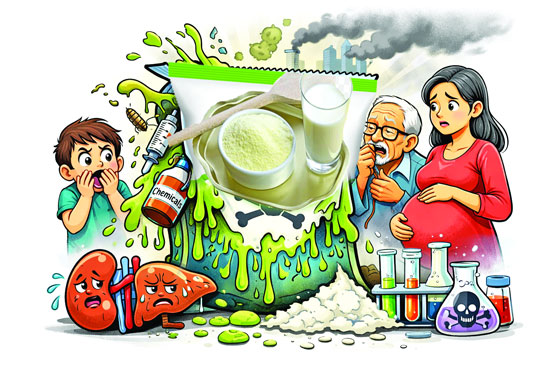
A shocking investigation has revealed that more than 67 percent adulteration has been found in popular powdered milk brands sold across Bangladesh, triggering serious concerns over long-term health risks for children. Laboratory tests show that some products contain as little as 17 percent real dairy content, with the rest made up of low-cost fillers and harmful substances. The findings have alarmed parents, health experts, and regulators alike, as powdered milk remains a staple food for millions of children nationwide.
Parents across Bangladesh go to great lengths to ensure their children consume safe and nutritious food. Mirpur resident Khalilur Rahman, despite owning a grocery shop, prefers to buy food items for his only daughter from reputed department stores.”Even if it costs a little more, I believe branded products are safer for children,” he told Daily Industry. Similarly, Saleha Chowdhury, a resident of Paribagh, always chooses premium brands for her children, trusting that higher prices ensure better quality. But recent investigations have shattered that confidence. Laboratory tests have revealed that even so-called “good brands” of powdered milk contain alarming levels of adulteration. One popular brand, “Goalini Daily Full Cream Milk Powder,” was found to contain only 17% actual dairy content, while more than 67% consisted of adulterated substances, primarily low-cost “whey powder” and other fillers. This discovery has triggered serious concern among health experts, regulators, and parents, as powdered milk is a staple for millions of Bangladeshi children.
Adulteration Hidden behind Glossy Packaging: Investigations show that cheap whey powder-a by-product of cheese manufacturing-is being mixed with minimal dairy content and sold as premium milk powder. The glossy packaging and familiar brand names mislead consumers into believing the products are safe and nutritious. A senior food safety inspector told Daily Industry: “Ordinary consumers have no way to know that they are feeding their children fake milk. The packets look professional, carry fake certifications, and are sold in the market.
Shocking Lab Findings: Several months ago, food inspectors from Dhaka South City Corporation (DSCC) collected samples of Goalini Daily Full Cream Milk Powder. The product failed both chemical and physical tests. According to the laboratory report: Dairy content: Only 17.08%, Adulterated substances: 67.44%, Milk fat: Expected 42%, found 7.58%, Milk protein: Required minimum 34%, found 9.50%, Other adulterants: 8.52%.
The product also failed to meet nutritional values mentioned on the packaging, misleading consumers. Food safety officials said the product should have contained at least 76% dairy components, but the actual content fell drastically short.
Court Action and Arrest Warrant: Following the findings, the Pure Food Court ordered the withdrawal of the product from the market and imposed a Tk 3 lakh fine on the manufacturer. On December 10, Special Metropolitan Magistrate Nusrat Sahara Bithi issued the verdict.
The court also issued an arrest warrant against Mohammad Shahabuddin Alam, Chairman of SA Group of Industries, which produces Goalini milk powder. He later appeared in court, admitted guilt, sought mercy, and pledged to withdraw the adulterated product.
“Since the accused confessed, the court ordered destruction of the seized products,” said Mohammad Kamrul Hasan, Prosecuting Officer and complainant. Several cartons of the product were destroyed last month, officials confirmed.
More Brands Fail Tests: Investigators revealed that Goalini is not alone. Laboratory tests also failed: Aslam Tea Company’s full cream milk powder, The same company’s skim milk powder, Dano Full Cream, Danish Full Cream, Nestlé Instant Full Cream, Starship Milk Powder. Cases have been filed against importers of these brands, though enforcement remains weak.
A senior investigator told Daily Industry: “Even imported premium brands are failing tests. Our enforcement capacity is limited, and foreign manufacturers remain beyond our legal reach.”
Fake BSTI Logos Add to Deception: Many adulterated products display fake Bangladesh Standards and Testing Institution (BSTI) logos and QR codes. BSTI Coordination Officer Mohammad Touhidur Rahman said: “There are allegations that fake BSTI logos are being used on substandard products. That’s why we introduced QR codes so consumers can verify registration.”
He added: “If any BSTI-certified product is found adulterated, we take punitive action and conduct mobile courts.” Under the BSTI Act 2018, certification is mandatory for powdered milk, chocolates, biscuits, and baby food.
Substandard Imported Chocolates: Not only milk powder-popular imported chocolates are also failing safety standards. Recently, DSCC inspectors collected KitKat chocolates from a bakery in Fakirapul. Lab tests confirmed the product was substandard and unsafe.
Authorities filed cases under the Safe Food Act 2013. On November 3 last year, the court issued an arrest warrant against Mozammel Hossain, owner of Sumaiya Enterprise, the supplier based in Chawkbazar. Another product, Cokola Wafer, was also ordered to be withdrawn after failing tests.
Long-Term Health Risks for Children: Public health experts warn of devastating consequences. Dr Md Akhtar Imam, Deputy Director of Bangladesh National Nutrition Council, told Daily Industry: “Adulterated baby food creates long-term health risks. Children may develop kidney problems, impaired physical and mental growth, and permanent organ damage. Brain development can also be affected.”
He stressed: “This is a silent crisis. Strong law enforcement and public awareness are equally important.” Regulatory Gaps and Limited Capacity: Zakaria, Chairman of Bangladesh Food Safety Authority (BFSA), said: “Baby food is extremely sensitive. We regularly collect samples from markets. Our labs can test around 1,500 to 2,000 samples annually.”
He added: “We are expanding lab capacity through new projects. When we get complaints or detect suspicious products, we conduct raids.” However, officials admit manpower shortages, limited logistics, and legal constraints hamper large-scale monitoring.
Export and Import Oversight Weak: Regulators also struggle to control imported products. A senior official said: “We can punish importers, but foreign manufacturers are beyond our jurisdiction. Even after adulteration is proven, imports are rarely banned permanently.”
Parents Feel Betrayed: For parents like Khalilur Rahman, the revelations feel like betrayal. “We trust brands with our children’s lives. Now we feel helpless. Who should we trust?” he asked. Saleha Chowdhury echoed similar fears: “We pay extra thinking it’s safe. But even those are fake. It’s frightening.”
Experts Demand Tougher Laws: Consumer rights activists demand stronger punishment. Professor Tareq Mahmud, food safety researcher, told Daily Industry: “Fines of Tk 3 lakh are meaningless for big companies. Jail terms and business bans are needed to stop this.” He added: “Food crimes are equal to slow poisoning.”
What Consumers Can Do: Officials advise: Scan BSTI QR codes before purchase, avoid suspiciously cheap products, Report doubtful items to authorities, Buy from trusted sources. But experts say the burden should not fall on consumers alone.
A Growing Public Health Crisis: With more than two-thirds adulteration found in popular milk powder brands, Bangladesh faces a serious child nutrition crisis. Without strict enforcement, stronger laws, and accountability, millions of children remain exposed to harmful food every day. As Dr Akhtar Imam warned: “The damage may not show today, but it will appear years later. We are risking an entire generation.” Daily Industry will continue to investigate and report on food safety issues affecting public health.