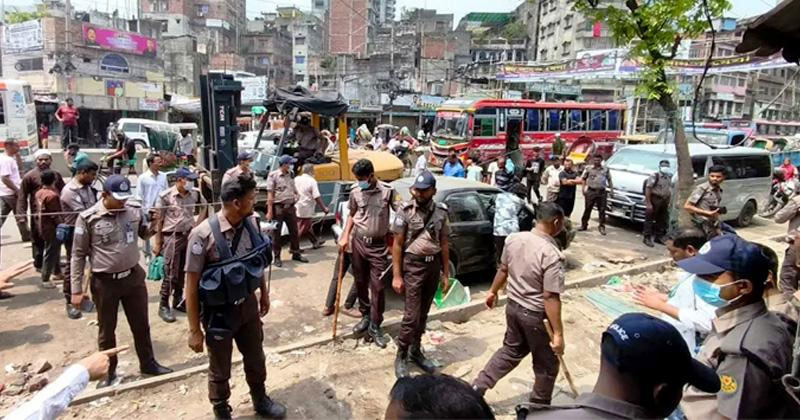
A coordinated eviction drive led by the traffic division of the Dhaka Metropolitan Police has brought visible relief to some of the capital’s most congested roads, with authorities pledging to sustain the momentum through continued enforcement and monitoring.
According to officials and on-the-ground observations cited by The Daily Industry, areas once notorious for severe congestion and illegal occupation—particularly Gulistan—have undergone a dramatic transformation over the past five days. Footpaths and road lanes that were previously blocked by makeshift shops, hawkers, and commercial spillovers are now largely open, allowing pedestrians and vehicles to move more freely. The first phase of the five-day drive concludes today (Sunday), with authorities already preparing to launch a second phase after a brief monitoring period aimed at preventing re-encroachment.
Noticeable Improvement in Traffic and Pedestrian Movement. Residents and commuters say the difference is striking. Where pedestrians once struggled to find space to walk due to rows of vendors and illegal extensions from shops, they can now use footpaths without obstruction. Similarly, traffic bottlenecks that used to paralyze key intersections for hours have eased considerably.
A commuter in Gulistan told The Daily Industry, “Earlier, it could take 30 to 40 minutes just to cross a short stretch because of congestion. Now vehicles are moving smoothly, and the roads feel much wider.”
The impact is not limited to one area. Similar improvements have been reported in multiple parts of the city, including Panthapath, Green Road, Malibagh, Rampura, and Uttara, where coordinated drives were conducted simultaneously.
Authorities Stress Sustained Enforcement: Speaking to The Daily Industry, DMP Additional Commissioner (Traffic) Md. Anichur Rahman said the operation is part of a structured, multi-phase plan rather than a one-off campaign.
“Since the start of the raid, we have successfully cleared key roads and footpaths in important areas. The first phase of five days ends today. After that, we will spend seven days ensuring that these areas remain free from illegal activities,” he said. He added that the second phase of eviction drives would begin immediately after the monitoring period, targeting new locations while maintaining previously cleared areas.
“Once people understand that roads cannot be occupied again, the tendency to reoccupy will decrease. Our goal is to make road movement permanently comfortable,” Rahman emphasized.
Widespread Violations Uncovered: Officials said the raid revealed extensive misuse of public spaces by a wide range of businesses. Restaurants had extended cooking facilities—including grills and stoves—onto sidewalks, while automobile workshops occupied entire road lanes for repair work. Shops selling garments, furniture, and other goods had also expanded operations onto public land. Such practices not only restricted pedestrian movement but also forced people onto busy roads, increasing the risk of accidents and contributing to chronic traffic congestion .A DMP official told The Daily Industry, “Footpaths are meant for pedestrians, but they were almost entirely taken over. This created both safety risks and traffic problems.”
Enforcement Actions: Fines, Arrests, and Seizures: The raid has been backed by strict enforcement measures, including fines, arrests, and confiscation of illegal structures and goods. On the fourth day alone, authorities collected fines totaling Tk 370,500 and handed down jail sentences to 13 individuals for violating regulations. Operations in areas such as Kotwali, Bangshal, and Nayabazar led to fines against multiple establishments and the arrest of offenders. In Jatrabari and Dholpur, illegal roadside businesses were evicted, with 16 traders fined Tk 31,500.
In the Panthapath to Green Road stretch, illegal parking was also targeted, resulting in dozens of cases filed against violators. Mobile courts imposed additional fines and carried out arrests. Significant enforcement actions were also reported in Malibagh, Rampura, Mohakhali, Mohammadpur, and Uttara, where dozens of shops were fined and illegal setups dismantled.
Economic and Social Dimensions: While the raid has been widely welcomed by commuters, it also raises questions about the livelihoods of informal sector workers, particularly street vendors.
Urban policy analysts note that many hawkers rely on roadside businesses for survival and that long-term solutions must balance urban order with economic inclusion.An urban development expert told The Daily Industry, “Eviction drives can improve traffic and public space management, but they must be complemented by rehabilitation plans for displaced vendors. Otherwise, the problem will resurface.” Authorities, however, argue that public safety and mobility must take precedence.
Monitoring to Prevent Re-Encroachment: The DMP plans to deploy dedicated monitoring teams over the next seven days to keep watch on previously cleared zones. Surveillance and regular patrols will be intensified to deter any attempts at reoccupation.
Officials say that without sustained monitoring; past efforts to clear roads have often failed, as encroachers gradually return. “We have learned from previous experiences. This time, monitoring will be strict and continuous,” a DMP official told The Daily Industry.
Public Response and Expectations: Public reaction to the activities has been largely positive, with many calling for the initiative to be expanded across the entire city. Drivers, commuters, and pedestrians alike have expressed relief at the improved traffic conditions and safer walking spaces.
A ride-sharing driver said, “If this continues, it will save us hours every day. Fuel costs will go down, and we can serve more passengers.” However, some citizens remain cautious, noting that similar drives in the past have failed to deliver lasting results.
Toward Sustainable Urban Management: The ongoing surveillances highlights the broader challenge of urban management in a densely populated мегacity like Dhaka. Experts stress that sustainable solutions will require not only enforcement but also better urban planning, designated vending zones, and coordination among city authorities.
As the first phase concludes and the second phase looms, the success of the initiative will ultimately depend on consistency, transparency, and the ability to address both enforcement and social concerns. For now, the cleared roads of Gulistan and other stand as a rare example of how coordinated action can quickly transform urban mobility—if maintained over time.