The risk to the Bab al-Mandeb Strait, an important alternative waterway for bringing fuel oil from Saudi Arabia to Bangladesh, has increased due to the control of the Yemeni rebel armed group Houthi. This may increase the time and cost of importing fuel oil as well as create uncertainty in the supply system. However, the relevant parties said that this is not affecting the price of fuel oil in the domestic market right now. Because the government has already decided to keep the price of fuel oil unchanged for the month of September. However, if the Houthi control of the Bab al-Mandeb waterway lasts longer, a crisis may arise.
According to international Reuters, recently, the UN Special Envoy for Yemen, Hans Grundberg, told the UN Security Council meeting on September 10 that the establishment of Houthi control in Mokha has created a direct presence at the entrance to one of the world’s most important waterways. As a result, the risk of shipping in the Red Sea and surrounding waterways has increased.
Meanwhile, due to the gas crisis in Bangladesh, the government is trying to increase the use of liquid fuel in power generation. State Minister Anindya Islam Amit told Parliament that another Tk 6,000 crore is being provided to run oil-based power plants. At this time, the increase in oil prices in the international market may become more expensive for Bangladesh. As a result, the war in the Middle East may create new pressure not only on the global oil market, but also on Bangladesh’s energy security and economy. Although it is not expected that it will be passed on to the consumer right now.
Incidentally, in September, diesel is being sold at Tk 115 per liter, octane at Tk 145, petrol at Tk 140 and kerosene at Tk 135. This price has been effective from September 1. Earlier, the same price was maintained in June, July and August. Since the prices remained unchanged in September as well, the prices of diesel, kerosene, petrol and octane have not been increased or decreased for the fourth consecutive month.
Bab al-Mandeb Strait, a narrow waterway between Yemen and Djibouti at the entrance to the Red Sea. After Hormuz, it was being used as an alternative waterway for oil transportation, but the Houthis took full control of the Bab al-Mandeb Strait last Friday. They captured the port city of Mokha.
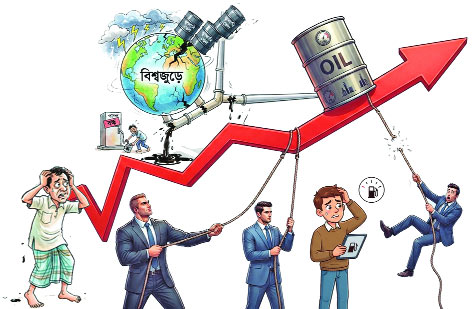
Crude oil prices have risen to their highest level in the last four months. Brent and West Texas Intermediate (WTI) prices have increased by about 13 percent in the last one week. The biggest rise in oil prices is now being seen in a week since mid-July. It is being sold at $104 per barrel in the international market on Sunday (September 13).
Energy related people said that Bab al-Mandeb had become an important alternative route for bringing fuel oil from Saudi Arabia to Bangladesh. Recently, to avoid security risks, a Bangladesh-bound fuel tanker had to avoid this strait and travel a long way. While it took about 16 days to reach Bangladesh via Bab al-Mandeb, it took about 50 days to make the detour. In this way, the additional cost of a tanker can be up to $4 million, according to ship related people.
An official of Bangladesh Petroleum Corporation (BPC) told Bangla Tribune on condition of anonymity that the Strait of Hormuz is one of the main waterways for importing fuel oil from the Middle East to Bangladesh. Shipping on that route was being disrupted due to the Iran war. In this situation, the route to bring oil from the Red Sea and Bab al-Mandeb from Yanbu port in Saudi Arabia to Bangladesh had become important. Now, the security risk at Bab al-Mandeb has also increased, creating new uncertainty in fuel oil imports.
However, due to this situation, it is not possible to say for sure whether the price of fuel oil in the domestic market will increase in the future. The government adjusts the price of fuel oil every month under the automatic pricing system, taking into account the international market price, import costs and the domestic market situation.
However, if the security risk at Bab al-Mandeb continues, how much the time and cost of importing fuel oil will increase and whether its impact will ultimately affect the domestic market will depend on the international market situation and the subsequent cost of imports.
Energy expert M. Tamim said, this will reduce the supply of fuel oil all over the world, including Bangladesh. As a result, the crisis will intensify. On the other hand, the price of fuel oil in the international market has already risen above $100. There is a fear of further increase in this price. Especially the price of diesel may increase. He said, the price of diesel per gallon in America has now exceeded six dollars, which is the highest. It may increase further. Oil.com, which works on the international oil market, reported in a news report that oil prices reached $119.48 in early March this year. If the current conflict spreads further, the price of oil may again go back to around $120 per barrel.