Even during the peak hilsa season, fishermen in Pirojpur’s rivers are failing to catch the expected amount of fish. Although one or two hilsa are occasionally caught in their nets, most are small and expensive, leaving fishermen and fish traders frustrated.
As the supply of fish has declined, many of them are also sinking deeper into debt. A visit to the confluences of the Kacha and Kaliganga rivers in Pirojpur found rows of boats carrying fishermen out to fish. However, despite casting their nets for two to three days, they were not getting the expected amount of hilsa.
Fishermen said that only a few years ago, large quantities of hilsa were caught in the Kacha, Kaliganga, Baleshwar and Sandhya rivers. The decline in hilsa catches has now raised concerns about the livelihoods of thousands of fishermen and fish traders in the district. The fish market at both ends of the Bekutia Bridge in Pirojpur usually becomes busy every afternoon.
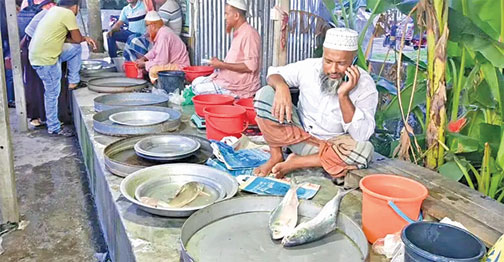
Local residents as well as travellers heading towards Khulna and Barishal used to buy hilsa there. But the market is now receiving little fish because of the reduced supply from the rivers. Many sellers were seen sitting with empty baskets. The limited hilsa available is also expensive. One-kilogram hilsa is selling for Tk 3,000-3,200 per kg, while fish weighing 500 grams to one kilogram costs Tk 1,800-2,500. As a result, many ordinary buyers are returning without buying hilsa.
Hilsa seller Shah Alam said there was hardly any hilsa even during the peak season. “Buyers cannot afford the fish, and we are also not getting enough supply. We are currently having to survive on loans. If jatka conservation is properly enforced, hilsa may return,” he said.
Humayun Kabir, who came to buy hilsa at the market beside Bekutia Bridge, said the market used to have an adequate supply of hilsa at prices affordable to ordinary people. He suspected that the construction of the bridge may have reduced water flow in the river, contributing to the decline in hilsa. Hilsa seller Rafiqul Islam said the supply was no longer what it used to be.
He blamed the decline partly on the catching of small fish and jatka. Although a few jatka are now being caught, their prices are high. A one-kilogram hilsa costs around Tk 3,000, he said, adding that the reduced supply had badly affected the fishing business. Another seller, Al-Amin Sheikh, said water levels in the rivers used to be much higher.
“Sandbars have formed in many places. The river current has declined and silt has accumulated since the construction of Bekutia Bridge. If the rivers are dredged and navigability restored, hilsa supplies may increase,” he said.
Hilsa buyer Jamal Hossain said the market used to have a good supply of hilsa at prices within the reach of ordinary consumers.
“Now the supply is low, so prices have also increased. It is difficult for ordinary people to buy hilsa at such high prices,” he said.
Fishermen alleged that illegal nets and the catching of jatka were also contributing to the decline in hilsa stocks.
They further claimed that the construction of the Eighth Bangladesh-China Friendship Bridge, locally known as Bekutia Bridge, had reduced the river’s current and caused siltation, leading to reduced navigability. However, the relevant authorities’ views are needed regarding the claim that the bridge has affected hilsa supplies.
According to district fisheries department data, around 1,600 metric tonnes of hilsa are produced in Pirojpur’s rivers each season, with an estimated market value of around Tk 200 crore.
Pirojpur District Fisheries Officer Sanjib Sannamat said hilsa is a marine fish and that its presence in the rivers had declined because of navigability problems and submerged sandbars at river mouths.
However, he said sufficient quantities of sea-caught hilsa were being traded at a landing centre in Pirojpur and sent to different parts of the country.
He said around 30,000 fishermen were engaged in river and sea fishing in Pirojpur and that they were receiving various forms of government assistance.
Locals said restoring navigability through river dredging, strengthening monitoring to protect jatka and taking effective measures against illegal fishing nets could help revive Pirojpur’s traditional hilsa fishery.