Zarif Mahmud
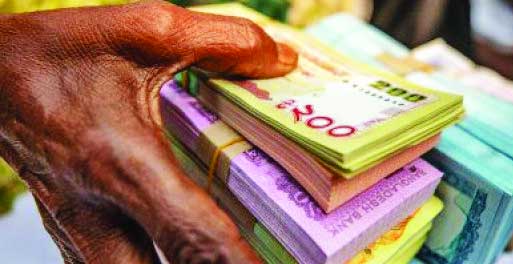
Bangladesh’s banking system is witnessing a notable trend: a steadily increasing amount of cash is being held outside the formal financial sector. At the end of June 2025, the total cash outside banks stood at Tk 2,96,000 crore, reflecting a 2.02 percent increase compared to Tk 2,90,000 crore during the same period last year. This steady rise in cash holdings is raising concerns among economists, bankers, and policymakers about public confidence in the financial system and the broader implications for economic growth.
Slow Deposit Growth Reflects Economic Strain: Analysts point out that the growth in bank deposits has slowed significantly due to ongoing inflationary pressures and sluggish private sector investment. As of June 2025, total deposits in the country’s banking sector reached Tk 18,78,000 crore, marking a 7.77 percent increase from the previous year. While this growth is slightly higher than the 7.73 percent recorded in May, it remains notably below the 9.25 percent growth observed in June 2024.
The downward trend in deposit growth has been persistent. The lowest recorded growth in the last 18 months was in August 2024, when deposits grew by just 7.02 percent. Although there was a temporary uptick in early 2025, growth has declined again since April.
Experts believe that this slowdown reflects the broader constraints on household savings, as income growth remains limited amid a sluggish investment environment.
“Deposits generally rise when inflation eases, but without new job creation and rising incomes, the capacity to save is constrained,” explained a senior banker on condition of anonymity. “The public’s limited ability to save is directly linked to slower deposit growth, despite some temporary reductions in inflation in recent months.”
Inflation and Limited Income Growth Restrict Savings: Data from the Bangladesh Bureau of Statistics (BBS) indicate that after a brief decline, inflation surged again to 8.55 percent in July 2025. The increase was driven by simultaneous rises in the prices of food and non-food items. This upward inflationary pressure is creating a double burden on households, as wages and incomes are not keeping pace with rising costs.
The central bank has set an ambitious target of maintaining inflation within 6.5 percent for the 2025-26 fiscal year. However, economists argue that achieving this goal will require not only careful monetary management but also structural reforms to boost investment and job creation, which in turn can support household savings.
“The public is cautious, holding more cash outside banks as a hedge against uncertainty,” said Dr. Hasan Mahmud, an economist based in Dhaka. “When people feel insecure about banks’ stability or their own income prospects, they prefer liquidity in hand over deposits.”
Private Sector Credit Growth Remains Weak: A significant factor contributing to this cautious stance is the sluggish growth in private sector credit. According to Bangladesh Bank data, credit growth in the private sector reached only 6.40 percent in June 2025. This is the second instance this year that credit growth has fallen below 7 percent.
Bankers attribute the slow credit growth to multiple factors. Weak lending demand due to low private investment, reports of irregularities in lending, and the struggles of certain banks to repay depositors have all eroded public trust. “People are wary of depositing funds or borrowing when confidence in the sector is fragile,” explained a senior economist.
Public Confidence and the Shadow Economy: The increasing cash outside the banking system is often seen as a proxy for public confidence-or lack thereof. When people keep money outside banks, they limit its circulation within the formal economy, reducing the efficiency of monetary flows and limiting credit expansion. Economists warn that such behavior could have long-term repercussions.
“When cash remains in people’s hands rather than in banks, the creation of new money through lending is constrained,” said Dr. Mahmud. “This reduces liquidity for businesses and slows down economic growth. The more the public hoards cash, the less the banking sector can facilitate productive investment.”
This behavior also underscores the informal economy’s resilience. Cash outside banks often circulates through informal channels, evading formal financial oversight. While it provides immediate liquidity to individuals, it can hinder the government’s ability to manage monetary policy effectively, especially in a rapidly evolving economic environment.
Government and Central Bank Responses: In response to these trends, Bangladesh Bank and the government are exploring measures to restore public confidence and encourage deposit growth. Some of the proposed steps include offering higher interest rates on savings deposits, strengthening oversight to prevent bank irregularities, and incentivizing digital financial services.
“Restoring trust is critical,” said a spokesperson from Bangladesh Bank. “We are monitoring the situation closely and will implement necessary policies to ensure that depositors feel secure in keeping their funds in banks.”
Moreover, financial experts suggest that improving the transparency and governance of the banking sector could also help. Weak enforcement of banking regulations and the occasional exposure of irregular lending practices have left depositors uncertain about the safety of their funds. Ensuring timely action against banks with governance lapses could send a positive signal to the public.
Implications for Economic Growth: The trend of increasing cash outside banks has broader economic implications. Limited deposit growth and weak private sector credit expansion can constrain investment, slow industrial activity, and reduce the overall multiplier effect in the economy.
Economists caution that if the pattern continues, it could hamper Bangladesh’s efforts to achieve sustainable economic growth. With more money held outside the banking system, businesses may struggle to access loans for expansion, while the government may face challenges in mobilizing resources through financial markets.
“The economy thrives on the circulation of money,” emphasized Dr. Mahmud. “Cash hoarded outside banks reduces this circulation, making it difficult for monetary policy to achieve its intended effects.”
Sectoral Impact: The impact is being felt across multiple sectors. Small and medium enterprises (SMEs), which rely heavily on bank loans for working capital, are finding it increasingly difficult to secure credit. Large corporations also face hurdles in accessing affordable financing as banks remain cautious about lending in an environment of rising non-performing loans.
In addition, sectors such as real estate, manufacturing, and services are seeing slower credit uptake, which could affect employment generation and investment. Analysts argue that unless deposit growth is restored and public confidence improves, the broader economy may continue to experience stagnation.
Looking Ahead: The central question for policymakers is how to balance liquidity management, inflation control, and deposit mobilization. While the public’s preference for cash reflects a cautious approach in uncertain times, it poses challenges for banks and the wider economy.
Experts recommend a multi-pronged approach: enhancing regulatory oversight, ensuring banking sector stability, incentivizing deposits through attractive interest rates, and promoting financial literacy to rebuild trust. Additionally, stimulating private sector investment through targeted fiscal and monetary measures could boost incomes, encouraging higher savings and deposit growth.
“The trend is a warning signal,” noted Dr. Mahmud. “If unchecked, increasing cash outside banks could undermine the banking system’s ability to support growth. Policymakers must act decisively to restore confidence and encourage formal financial participation.”
Bangladesh’s financial system faces a delicate balancing act. The increase in cash outside banks, alongside slow deposit growth and weak private credit expansion, underscores the public’s caution amid economic uncertainty. Inflationary pressures, slow income growth, and occasional banking irregularities have collectively eroded public trust, prompting many to hold liquidity in hand rather than in banks. While the situation is challenging, it is not irreversible. Coordinated action by the central bank, the government, and the banking sector could restore confidence, stimulate deposits, and support the economy’s growth trajectory. The key lies in addressing both the structural and psychological factors that drive the public to hoard cash and ensuring that the banking system becomes a reliable and accessible vehicle for savings and investment.