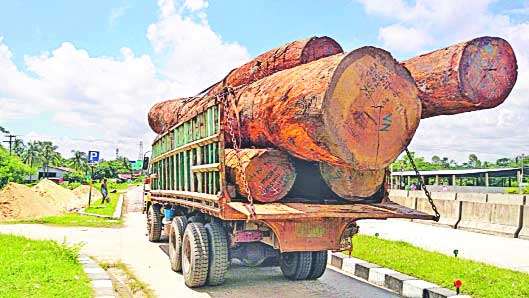
Goods vehicle drivers across Bangladesh are routinely flouting the axle load policy, transporting goods far beyond the legal weight limits. This reckless practice is causing severe damage to the nation’s roads and highways and contributing to frequent accidents, highlighting serious lapses in enforcement and supervision. Sources from the Roads and Highways Department (RHD) confirm that despite the government introducing the axle load policy in 2012 to curb overweight vehicles, compliance remains minimal even after 13 years.
Overloaded Vehicles Endanger Roads and Lives: According to RHD sources, vehicles often operate at several times their permissible carrying capacity, damaging roads, highways, and bridges prematurely. Drivers and their assistants frequently overload trucks out of financial greed, ignoring the potential consequences. Overloaded vehicles not only accelerate the deterioration of pavement surfaces but also increase the risk of accidents. Reports indicate that numerous traffic accidents in various districts have been directly linked to vehicles carrying excess weight.
The problem is compounded by poor supervision and lax enforcement of the law. While the axle load policy exists on paper, implementation has been inconsistent, allowing vehicles to regularly exceed their weight limits without facing penalties. Legal Weight Limits and Fines: Under the existing axle load policy, the temporary maximum weight limits are set based on vehicle type: Six-wheeled vehicles: up to 22 tons (including vehicle and goods), Ten-wheeled vehicles: up to 30 tons, Fourteen-wheeled vehicles: up to 40 tons.
Vehicles exceeding these limits are subject to fines ranging from Tk 2,000 to Tk 12,000, depending on the severity of the overload. The fines are structured in four stages; for example, a six-wheeler carrying goods beyond 15 tons may face a fine of Tk 2,000, rising to Tk 12,000 for loads up to 19.5 tons. Similarly, a 26-wheeler exceeding 48.4 tons may be fined Tk 2,000, with the maximum penalty reaching Tk 12,000 for loads up to 55 tons. Axle load control stations have been established along major highways and bridges to measure vehicle weights and impose fines. Despite these measures, compliance remains poor, and overloading continues to be rampant.
Roads Being Destroyed Prematurely: Sources indicate that Bangladesh’s roads and highways, constructed at substantial public expense, are deteriorating at an alarming rate due to overloaded freight vehicles. Legally, a single axle should carry no more than 10 tons, but trucks often operate with axle loads of 20 tons or more. Even small vehicles frequently carry double their prescribed load.
Substandard road construction exacerbates the problem, and in some areas, enforcement is undermined by allegations of bribery, allowing overweight vehicles to operate unchecked. Bailey bridges, in particular, have collapsed in several instances due to repeated overloading.
Experts warn that transporting goods at two to three times the legal weight severely damages road surfaces. Common effects include cracks, lifting of bitumen layers, and the formation of potholes within months of road construction or repair. The financial cost of repairing roads and highways damaged by overloaded vehicles runs into thousands of crores of taka annually.
Vehicle Capacity and Manufacturer Guidelines: Each vehicle has a manufacturer-determined weight limit. According to the Blue Book: Six-wheeled, four-axle vehicles: 15.5-16 tons, Ten-wheeled vehicles: 26 tons, Prime movers (four-axle): 33 tons, Prime movers (five-axle): 42 tons.
Exceeding these limits not only violates the law but also significantly reduces the lifespan of roads and bridges. Transporting goods beyond capacity is therefore both illegal and economically damaging.
Government and RHD Measures: Additional Chief Engineer of the Roads and Highways Department, S. M. Ilyas Shah, said that the axle load policy is currently in effect and efforts are being made to enforce it more rigorously. Weight limit control scales have already been installed at several key locations, and the RHD plans to set up new scales at 21 additional points along major highways. Shah emphasized that once these measures are fully implemented, significant improvements in road preservation and traffic safety are expected. Despite these initiatives, enforcement challenges remain, and long-term solutions will require consistent monitoring, stricter penalties, and accountability at all levels of the transport sector. Experts stress that without full compliance, the country’s high-cost road infrastructure will continue to degrade rapidly, resulting in higher maintenance costs and increased accident risks. Public Safety and Economic Concerns: The ongoing negligence by freight operators has broader implications beyond road damage. Overloaded vehicles increase the likelihood of accidents, jeopardizing the safety of both drivers and passengers on highways. Moreover, the frequent need for repairs due to premature road damage imposes a heavy economic burden on the government and, ultimately, taxpayers. The RHD has urged transport companies and drivers to strictly adhere to the axle load limits to ensure road longevity and reduce accident risks. While technology, such as weight measurement scales and surveillance systems, plays a critical role, the commitment of drivers and vehicle owners to follow the law is equally vital. Bangladesh’s highways and bridges, built with significant investment, are under threat due to persistent overloading by goods vehicles. The 2012 axle load policy, intended to protect roads and ensure traffic safety, is not being followed, causing accelerated deterioration of infrastructure and increasing accident risks. Experts, RHD officials, and law enforcement authorities agree that strict enforcement of weight limits, expansion of control stations, and public awareness campaigns are necessary to mitigate this growing problem.
Unless freight operators, regulatory authorities, and the government work in unison to enforce axle load rules, the country will continue to face costly road repairs, frequent accidents, and the economic consequences of damaged transport infrastructure.