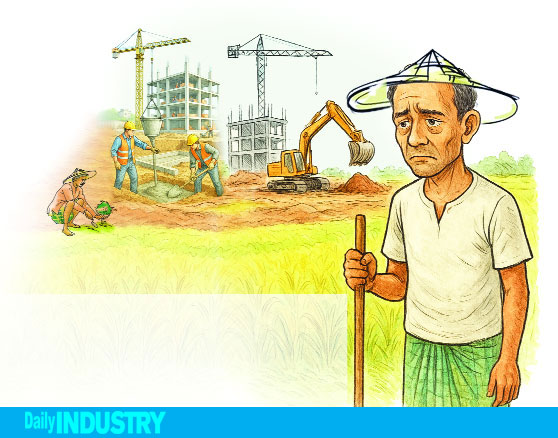
Bangladesh is losing an alarming amount of its agricultural base every year, with 68,760 hectares of arable land being converted to non-agricultural use annually, according to data from the Soil Resources Development Institute (SRDI).
This consistent decline has sparked grave concern among agricultural experts, economists, and food security advocates who warn that the country’s future food production capacity is at serious risk unless immediate action is taken.
A Growing Problem: The rapid transformation of farmland into residential areas, industrial zones, roads, and commercial infrastructure is largely driven by the country’s fast-paced urbanization and population growth.
Experts say the annual loss of 68,760 hectares - which is roughly equivalent to losing more than 95,000 football fields each year - could undermine decades of agricultural progress in Bangladesh, especially if no effective regulatory measures are enforced. “Farmland is disappearing faster than ever before, and with it, our ability to ensure food security for the growing population is slipping away,” said Prof. M.A. Sattar Mandal, former Vice Chancellor of Bangladesh Agricultural University. “This rate of loss is not sustainable. We cannot build factories and homes on all our cropland and still expect to feed the nation.”
Long-Term Consequences: This land loss is not only about quantity. Many of the lands being converted are among the most fertile and productive, supporting multiple cropping cycles a year. The result is a direct hit to food production potential.
According to the 2019 Agriculture Census, Bangladesh had around 18.68 million acres (approximately 7.55 million hectares) of agricultural land. That number continues to fall, now estimated at 7.88 million hectares in 2023, compared to 8.11 million hectares in 2021. This trend translates into a projected loss of over 687,000 hectares in the next decade, unless the conversion rate slows - a development that would significantly shrink the area available for rice, vegetables, and other essential crops.
As Bangladesh strives to balance rapid urban and industrial growth with its longstanding agricultural heritage, a silent and systemic challenge is gathering momentum: the continuous loss of arable and agricultural land. Recent data suggest that unless addressed urgently, this trend could jeopardize the country’s food self sufficiency and rural livelihoods. Urbanization and Policy Gaps: One of the key drivers behind the yearly loss of arable land is unregulated urban expansion. Cities are sprawling into fertile rural areas without adequate land-use planning.
Although the “Agricultural Land Protection and Land Use Policy” was introduced in 2011, enforcement has been weak. A more robust version, Land Zoning and Agricultural Land Protection Ordinance 2025, is currently under review, but experts argue that enforcement remains the missing link. ASM Saleh Ahmed, Senior Secretary at the Land Ministry, recently stated: “Our land is limited and its value is growing. We must utilize it wisely. A comprehensive zoning plan is necessary to protect agricultural areas.”
Profitability and farmer behaviour: Many farmers are selling their land or are being compelled to shift away from cultivation as production costs rise (fertilisers, labour, mechanisation) and returns come under pressure. In areas close to urban centres, the monetary incentive to sell farmland for housing or industrial use is strong.
Soil fertility degradation and cropping stress: Even where land remains under cultivation, soil health is under strain. A study published in a Bengali daily reported that about 75 % of the country’s land area now suffers from fertility deficiency; soils are being increasingly over cultivated (4 5 crops per year), relying heavily on chemical fertilisers and pesticides. This reduces the long term productive capacity of farmland, effectively rendering each hectare less capable over time. Voices from the Field: Expert Commentary: Prof M.A. Sattar Mandal, former Vice Chancellor of the Bangladesh Agricultural University: “It is falling and there is no doubt about it … Rural and urban settlement is increasing in line with population growth. We see the building of facilities even in the middle of the cropland.” Prof Mandal warns that without curbing conversion of farmland for non farm use, Bangladesh will struggle to feed a growing population. Prof Shahidur Rashid Bhuiyan, former Vice Chancellor of the Sher e Bangla Agricultural University: “This is a matter of grave concern. The population is growing while the farmland needed to produce food is shrinking … We are behind India, Pakistan and Sri Lanka in terms of yield.” He emphasizes that loss of land and sub optimal yields combine to raise risks for food security.
Professor Manjurul Hasan, Dept. of Geography & Environment, Jahangirnagar University: “Due to high population and demand, settlements and industries are being built rapidly in Bangladesh. This development is impacting our land resources. … If we don’t take urgent action, the situation will deteriorate further, threatening food security and environmental sustainability.”
Dr Md Abdul Quddus, Senior Scientific Officer of Soil & Water Management at Bangladesh Agricultural Research Institute (BARI): In an interview: “We are growing crops 5 6 times on the same land … We are seeing soil fertility collapse, nutrient deficiency across large areas.” His warning touches on the hidden erosion of the land base, not only in size but in quality.
Implications for Food Security and the Rural Economy: The decline in agricultural land has serious implications: Reduced flex capacity for staple food production: Bangladesh continues to cultivate rice, wheat, vegetables and pulses. But converting land to nonfarm uses reduces the margin available for expansion, intensification or buffer in case of shocks (e.g., floods, pests).
However, experts caution that this compensation has limits: soil health, varietal potential, climate risk and resource intensity set ceilings on how much more yield gains can offset land loss. What Needs to Be Done: Policy and Practice: Given the trajectory, a robust, multi dimensional strategy is imperative: Strengthen land use zoning and enforcement. Bangladesh needs clear zoning-identifying and protecting high value agricultural land, restricting nonfarm conversion, and enforcing penalties for violations. Currently, the gap between policy and practice is large.
Prioritise high potential croplands: The land best suited for intensive cropping (double or triple harvests) should be given special protection. Converting these lands has a multiplier effect in lost productivity.
Improve soil health and sustainability: With remaining land under stress, boosting soil fertility, reducing input over use, expanding integrated pest/soil management and crop rotation are vital. Soil degradation undermines long term yields even on retained land.
Promote alternative crops and efficient farming systems: Where land is lost or marginal, innovations such as vertical farming, rooftop agriculture, hydroponics, and agro forestry could help complement field based production.
Strengthen rural livelihoods and land tenure security: Ensuring farmers feel ownership or secure tenancy encourages long term investment in land. If farmers anticipate losing land, they have less incentive to maintain soil. Also linking farmers into value chains, mechanisation and efficient services matters. Raise public awareness and integrate land into national development plans: Farmland is a finite national resource-advertising, public education and inclusion in curricula can help change how society treats agricultural land. Urban infrastructure planning must include agricultural land as part of national food security and environmental policy. Track and publish data transparently: Accurate, timely monitoring of land conversion, cropping intensity, soil health and agrarian access is essential. For instance, the survey by BBS showed nearly 2 % land loss between 2015 2023 with quantified area.
If the current trajectory continues unchecked, Bangladesh could face: Increased dependence on food imports, pressuring foreign exchange and adding exposure to global price shocks. Loss of capacity to respond to climate and disaster related shocks due to reduced buffer land and degraded soils. Deepening rural poverty, higher migration to cities, and socio economic stress. Plateauing or even declining yields if soil health, land base and cropping intensity reach limits. Environmental degradation - less farmland means more pressure per hectare, increased pesticide/fertiliser use, erosion, biodiversity loss and ecosystem stress.
Bangladesh’s agricultural story to date has been one of remarkable achievement - raising production, feeding a growing population, and transforming the agrarian economy. But that story is increasingly under threat from the erosion of the very resource that underpins it: fertile land.
The annual conversion of tens of thousands of hectares of arable land to nonfarm use - and the degradation of the remaining land base - cannot be dismissed as a mere side effect of development. It is a structural challenge to food security, economic resilience and rural livelihoods. As Prof Mandal warns: “Bangladesh’s population will exceed 20 crore, and it will be impossible to ensure food for all if we cannot stop the conversion of agricultural land to nonfarm uses.”