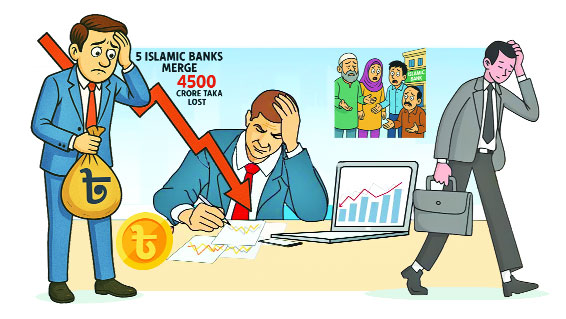
The government’s decision to merge five Shariah-based banks into a single large Islamic bank has triggered widespread anger among investors after Bangladesh Bank declared that all existing shares of these banks have become “completely worthless.” The move, aimed at saving the financially distressed institutions, has caused a combined loss of Tk 4,500 crore for general and institutional shareholders - leaving them without any compensation.
According to The Daily Industry, the affected banks - First Security Islami Bank, EXIM Bank, Social Islami Bank, Union Bank, and Global Islami Bank - were formally brought under a merger order issued by the central bank earlier this week. Following the announcement, trading of their shares on both the Dhaka Stock Exchange (DSE) and Chattogram Stock Exchange (CSE) was suspended on Thursday. Tk 4,500 Crore in Shareholder Losses: Data from the Dhaka Stock Exchange show that the five banks had a combined total of 582 crore issued shares, each with a face value of Tk 10. Of these, general and institutional investors held about 443 crore shares, with a total face value of Tk 4,433 crore. Before trading was halted, the market value of these shares was estimated at Tk 1,022 crore, reflecting the already weakened condition of the banks.
However, in a shock announcement, Bangladesh Bank Governor Dr. Ahsan H. Mansur declared that shareholders of the five banks will not receive any shares in the newly formed entity. He explained that all five banks had negative net asset values, with deficits ranging from Tk 350 to Tk 420 per share - effectively rendering their equity holdings valueless.
“The merger will protect depositors’ funds and stabilize the banking system,” Dr. Mansur said. “But since these institutions have liabilities far exceeding their assets, shareholders cannot be compensated under the law.”
“This Is Not a Merger - It’s a Bailout,” Says CFA Society President: Experts and market observers described the move as a government-led bailout rather than a typical merger. Asif Khan, President of the CFA Society Bangladesh, told The Daily Industry that the central bank’s decision reflects a rescue operation financed indirectly by taxpayers, not a restructuring that benefits investors.
“It is misleading to call this a ‘merger,’” Khan said. “This is effectively a bailout of depositors using public funds because the banks’ assets are insufficient to cover their liabilities. Under bankruptcy law, depositors are paid first, followed by employees, bondholders, and finally shareholders - who, in this case, are left with nothing.”
Khan added that the government is constrained by its current commitments under the International Monetary Fund (IMF) austerity program, which limits its ability to compensate shareholders. “Given the IMF’s strict conditions and fiscal constraints, the government is in no position to offer financial relief to investors,” he said.
Market Reaction: Investor Fury and Calls for Accountability: The announcement sparked outrage among thousands of small investors who saw their holdings wiped out overnight. Many expressed frustration that regulators and the government failed to intervene earlier, allowing these banks to trade freely despite their deteriorating balance sheets.
Investors gathered outside brokerage houses in Dhaka on Thursday, accusing the central bank and the finance ministry of negligence. “We were misled by false financial statements and optimistic disclosures,” said one small investor from Uttara. “If the banks were insolvent, why did the regulators allow trading in their shares until yesterday?”
Saiful Islam, President of the DSE Brokers Association, acknowledged that the central bank’s move aligns with international banking practice but admitted that investors were blindsided. “The Governor’s statement is correct from a global regulatory perspective,” Islam told The Daily Industry. “But the reality is that many small investors were misled by deceptive accounting and inflated earnings reports. The government could still consider offering some limited relief - perhaps a token allocation of shares in the new bank - as goodwill gesture to protect retail confidence.”
Breakdown of Bank Share Values: According to market data compiled by The Daily Industry: First Security Islami Bank issued 113 crore shares with a face value of Tk 1,130 crore; its market value stood at Tk 215 crore before suspension. Social Islami Bank had 100 crore shares, with a market value of Tk 301 crore. EXIM Bank issued 97 crore shares, valued at Tk 293 crore. Global Islami Bank had 84 crore shares, valued at Tk 142 crore. Union Bank had 47 crore shares, valued at Tk 71 crore. Combined, these represent the Tk 4,500 crore loss in face value now effectively written off.
Deposit Protection, Not Shareholder Compensation: A top official at a leading merchant bank explained to The Daily Industry that under existing financial regulations, shareholders are the last in line for any recovery from failed institutions. “When a bank collapses, depositors are prioritized,” the official said. “These five banks cannot even cover depositor liabilities, so legally and financially, shareholders are not entitled to any compensation.”
He added that the government’s proposed Tk 20,000 crore recapitalization plan - intended to restore solvency in the merged bank - should focus exclusively on protecting depositors, not investors. “The recapitalization should serve the stability of the financial system. Diverting funds to shareholders would be both unethical and economically unsound,” he said.
IMF Conditions Tighten the Fiscal Grip: Economists point out that Bangladesh’s IMF loan program, which includes stringent conditions on fiscal transparency, deficit control, and financial governance, leaves little room for politically motivated compensations. “The IMF will not allow the government to use public money to rescue investors in insolvent banks,” said economist Dr. Zahid Hossain, a former World Bank lead economist, in comments cited by The Daily Industry. “The focus has to remain on protecting depositors and restoring discipline in the banking sector.”
He noted that Bangladesh’s Islamic banks have long been plagued by poor corporate governance, politically influenced lending, and chronic undercapitalization. “This merger should serve as a wake-up call for the entire banking system,” he added.
Anger Mounts among Shareholders: Despite these explanations, many retail investors remain furious, arguing that the government and regulators bear partial responsibility for the massive losses. “The Bangladesh Bank knew for months that these banks were insolvent,” said an aggrieved shareholder of Social Islami Bank. “Yet, they allowed them to operate and trade in the stock market. Ordinary investors trusted the system and lost everything.”
Several investor groups have called for a parliamentary inquiry into the crisis, demanding accountability from auditors, boards, and bank management who allegedly falsified reports to conceal losses. “We deserve transparency,” said Mahfuz Rahman, a shareholder of EXIM Bank. “If fraud or negligence is found, the people behind it must be prosecuted.” Market Analysts Warn of Confidence Crisis: Analysts fear the debacle could trigger a wider confidence crisis in Bangladesh’s already fragile capital market, particularly among retail investors who dominate trading volumes. “This event will damage investor trust not just in Islamic banks but in the entire financial sector,” said Asif Khan of CFA Society Bangladesh. “Without proper governance, mergers and bailouts will only erode market credibility further.”
Stock market analysts also warn that if the government fails to communicate a clear plan for the merged bank’s operations and future listing, panic selling could spill over to other financial stocks once trading resumes.
A Turning Point for Banking Reform: Despite the turmoil, some experts see the merger as a necessary corrective measure. “It is painful but essential,” said one senior banker. “Bangladesh’s banking sector can no longer afford to carry zombie institutions that survive only through regulatory indulgence.”
The banker added that the formation of a single, well-capitalized Islamic bank could improve efficiency, reduce systemic risk, and restore depositor confidence - but only if accompanied by strict oversight and professional management.
The Road Ahead: As the government prepares to finalize the structure of the new bank, uncertainty looms large for thousands of shareholders who have lost everything. Under IMF supervision and tight fiscal control, compensation appears unlikely, at least in the near term. “The priority now is depositor protection and systemic stability,” said a senior finance ministry official. “Unfortunately, shareholders must bear the consequences of the risks they took.” For now, small investors across Bangladesh feel abandoned. As one retail investor told The Daily Industry, “We trusted the system, we trusted the government, and we trusted the market. Today, all three have failed us.”