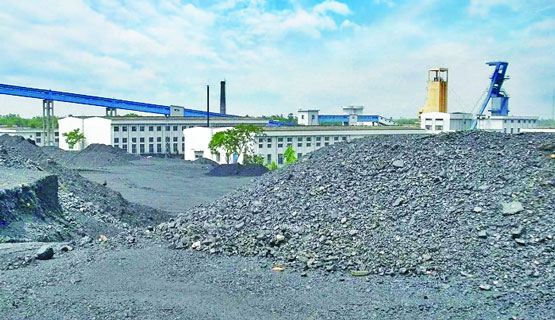
Bangladesh’s only operational coal mine at Barapukuria is now passing through one of its worst crises in years, with extraction continuing under contractual obligation but the adjacent coal-fired power plant almost entirely shut. This mismatch between production and offtake has pushed coal stockpiles to levels far beyond the mine’s safe storage capacity, raising fears of landslides, spontaneous combustion, and a potential shutdown that could deepen the country’s existing energy instability.
Despite Bangladesh possessing five discovered coalfields-Barapukuria, Phulbari, Khalashpir, Dighipara, and Jamalganj-only Barapukuria has been in commercial production for decades. Its output has historically been used almost entirely by the nearby 525MW Barapukuria Thermal Power Plant. This system worked efficiently when the power plant ran at stable capacity, but since two of the three generating units have been idle for months and the remaining one operates on and off, the mine is now producing coal that has nowhere to go.
Coal Stockpiles Reach “Dangerous and Unmanageable Levels”: Officials at Barapukuria Coal Mining Company Ltd (BCMCL) say the mine currently has over 4.40 lakh tonnes of coal stored across two internal yards and one yard under PDB control. The safe combined storage capacity is only 2.22 lakh tonnes, meaning the current stockpile is almost double the allowable limit. Yards that normally store coal at 5-7 metres height now contain heaps nearing 20 metres, creating high-risk conditions.
One senior BCMCL official, requesting anonymity, told Daily Industry: “This is no longer a normal operational issue. We are sitting on a mountain of coal that cannot be stored safely. Each additional tonne increases the likelihood of a slide or fire.”
According to officials, the mine had no choice but to continue extraction as it is bound by contract with the Chinese mining contractor. Work is ongoing at the 1406 longwall face, from which roughly 300,000 tonnes have already been extracted since August. Another 100,000 tonnes are expected by mid-December. Next year, the 1309 face is scheduled to open, which requires continuous tunneling and preparation work that cannot be halted.
Power Plant Not Taking Coal Since 12 November: The crisis escalated after the Barapukuria Thermal Power Plant began reducing coal intake in late October due to mechanical problems. By 12 November, PDB stopped taking coal altogether. The three units of the 525MW plant are currently in the following condition:
Unit 1 (125MW): Operating intermittently; requires 650-700 tonnes/day rather than the usual 1,200 tonnes. Unit 2 (125MW): Completely shut down for an extended period. Unit 3 (275MW): Under major overhaul; expected to remain closed until January next year.
A PDB official admitted the downturn, saying, “Our units are not fully operational. Maintenance issues and overhaul schedules have limited our capacity. For now, our coal requirement is almost zero.”
The power plant has informed BCMCL that coal intake may remain halted for another three months.
BCMCL Requests Approval to Sell Coal to Private Buyers: With no buyer, the mine has asked the Energy and Mineral Resources Division for permission to sell coal to industrial consumers such as cement factories, steel mills, and brickfields. Currently, commercial sale is not allowed without special approval because the mine’s output is earmarked exclusively for the power plant.
BCMCL Managing Director Abu Taleb Farazi confirmed the request: “The power plant is not taking coal, but extraction cannot stop. If we do not open the market now, extraction plans for the next year will be jeopardized. We are waiting for ministerial approval to sell coal to outside buyers.”
According to BCMCL, even selling 100,000 tonnes to private buyers in the next two months would greatly reduce risk.
Spontaneous Combustion Risk Rising: Coal stored at high volume generates internal heat. When this heat builds up, the coal can ignite on its own - a phenomenon known as spontaneous combustion. Barapukuria has experienced small fire incidents in previous years, particularly during winter. A mine safety engineer said: “The coal heaps are generating heat, and water spraying is not enough. The height is too much. If one section ignites, the fire will travel underground and become extremely difficult to control.”
Experts fear that a serious fire could force a shutdown of extraction for several months and inflict heavy financial losses on both BCMCL and the national power sector.
Coal Yard Walls at Risk of Collapse: Because of the excessive height, the slope of the coal piles has become unusually steep. During last year’s monsoon, a minor coal slide occurred that damaged a perimeter wall. Now, with coal loads nearly double, the risk is significantly higher.
A senior mine engineer warned: “If a major slide occurs, equipment, vehicles, and workers could be buried. This is not theoretical - the load is extremely heavy, and the angle of repose has been exceeded.”
Energy Experts Call It a Systemic Planning Failure: Energy economist Engr. Farid Uddin told Daily Industry: “This crisis shows the lack of coordination between the mining and power sectors. Extraction continues because of contractual obligations, while the power plant remains unreliable. This mismatch is a classic planning failure.”
He noted that despite the country’s chronic electricity shortages, the Barapukuria plant is producing almost no power, creating a double burden on the economy.
Former Petrobangla director Dr. Anwaruzzaman gave a stern warning:
“Barapukuria must urgently diversify its buyers. A single-buyer model for such a strategic mine is vulnerability. The crisis was predictable.”
Urgent Government Action Needed: Officials across BCMCL, Petrobangla, and the Energy Division agree that immediate action is necessary to stabilize the situation. The most viable short-term solution is granting approval for commercial coal sales.
One BCMCL official summarized the urgency: “If we cannot reduce the stockpile, extraction will be forced to slow or stop. That would create even bigger losses because the contractor will still have to be paid. The risk is getting more serious each day.”
The Barapukuria crisis highlights broader structural weaknesses in Bangladesh’s coal and power management. Unless swift measures are taken, the mine may face operational shutdown - not from lack of coal, but from an oversupply that has become too dangerous to handle.