Aspiring government job candidates are expressing frustration over the prolonged recruitment process for the Bangladesh Civil Service (BCS), which often exceeds four years. Despite hopes for reforms with the recent appointment of a new chairman and members of the Public Service Commission (PSC), many candidates remain sceptical about timely progress.
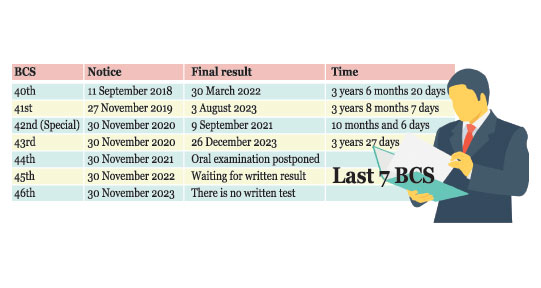
Job seekers have long been advocating for an increase in the age limit for government job eligibility, arguing that the current limit of 32 years is inadequate given the extensive time required to complete the BCS recruitment cycle. The PSC is legally bound to finalize recruitment within a year; however, historical data shows that the average time taken is closer to three and a half to four years.
The 40th BCS, for instance, took a staggering four years and one month from the notification date to the final appointment, while the 41st BCS took four years and three months. The 43rd BCS, although slightly quicker, still took almost four years to complete. In contrast, special BCS rounds typically finish within a year, highlighting significant discrepancies in processing times.
Educationists and public administration experts assert that a more efficient process could see BCS recruitment finalized within 15 to 18 months if the PSC were reorganized and managed effectively. PSC officials have attributed delays to political instability and unforeseen circumstances, such as national elections.
At a recent dialogue, PSC officials expressed their commitment to overcoming these challenges. Lt. Col. Rezaur Rahman mentioned that they have laid out a roadmap to streamline BCS processes, but implementation has been hampered by various external factors. The new PSC chairman, Professor Mobashwer Monem, acknowledged the urgency of the situation and promised to work towards restoring public trust in the commission. “We want to make an action plan that can be implemented,” he stated, emphasizing the need for transparency and integrity in the recruitment process.
Aspirants like Shefayet Hossain and Atiqul Islam, who have cleared preliminary exams for the 46th BCS, expressed cautious optimism about the changes in PSC leadership. They hope the new officials will expedite the recruitment process and improve overall efficiency.
Public administration experts are hopeful that with the right reforms and government support, the BCS recruitment process can be significantly improved, benefiting both job seekers and the state. The call for accountability and efficiency in the PSC remains a pressing issue as thousands await their chance at a government position.
In light of ongoing frustrations over the prolonged Bangladesh Civil Service (BCS) recruitment process, the new chairman of the Public Service Commission (PSC) has expressed a commitment to develop a feasible action plan aimed at streamlining BCS completions. The previous roadmap, established by former chairman Ikram Ahmed, aimed to finalize recruitment within one year but has faced significant shortcomings.
“We want to make an action plan that can be implemented,” the new PSC chairman stated, indicating a focus on practical solutions rather than theoretical frameworks. He emphasized that any previously laid plans will be assessed for their timeliness and practicality.
Former chairman Ikram Ahmed remains optimistic about the potential for reform, suggesting that with the right skilled manpower and government support, it is possible to complete at least one BCS cycle within 15 to 18 months. “I may not have been able to during my tenure, but I believe the PSC can implement it,” he remarked, advocating for a revaluation of the manpower structure to enhance efficiency.
The current BCS process has drawn criticism for its extensive delays, with many candidates waiting upwards of four years for completion. The PSC has acknowledged these issues and is seeking to restore public trust by promising greater transparency and accountability in future recruitments.