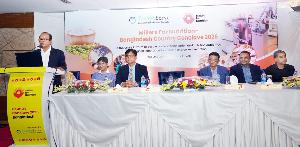
Bangladesh Bank Governor Dr. Ahsan H. Mansur has warned that the central bank will tighten its monetary policy further and raise interest rates if inflation does not show a noticeable decline by January. Speaking at an investor conference organized by BRAC EPL and Asian Tiger Capital Partners at the Sheraton Dhaka Hotel on Thursday night, Dr. Mansur expressed hope that inflation would decrease to 7% by June 2024 and eventually fall to 5% in the next fiscal year.
Dr. Mansur emphasized the government’s commitment to combating inflation through a strict monetary policy, including the removal of import duties on essential food items. “If inflation does not come down somewhat by January, we will have to take a stricter monetary policy,” he said, adding that a further increase in the policy interest rate is likely if inflation persists.
Currently, Bangladesh’s policy interest rate stands at 10%, with loan interest rates around 14%, which Dr. Mansur acknowledged is the highest in recent years. The Governor pointed out that despite measures such as tightening the monetary policy and restricting government borrowing, inflation has remained stubbornly high.
He attributed part of the inflationary pressure to a supply shortage, which was exacerbated by floods and prolonged rainy seasons affecting key crops like onions, potatoes, and winter vegetables. “The shortage in the supply of goods has become a big problem. I am hopeful that after two months, the prices of onions and potatoes will drop significantly,” he said, forecasting a price reduction to around Tk 30-40 per kg.
To alleviate the burden on consumers, the government has removed import duties on essential food items, and the Governor is optimistic that these measures will yield results by February 2024.
Dr. Mansur also reflected on the broader challenges the government is facing, noting that many of the current issues, including inflation, were inherited. “Everything that the government and Bangladesh Bank could do to control inflation has been done,” he said, but acknowledged that external factors such as global supply chain disruptions also play a significant role in the inflationary pressures.
Looking forward, the Governor emphasized that controlling inflation is a long-term process, and cited the experiences of countries like the US, UK, and Thailand, which have taken a year or more to stabilize inflation. “We are now waiting for the results,” he said, reaffirming the government’s goal of bringing inflation to 7% by the end of June 2024, with further reductions to 5% in the following fiscal year.
The conference featured prominent economists and industry leaders, including Dr. Zahid Hossain, Dr. Masrur Riaz, and other key stakeholders. Investors from around the world, including the United States, participated in the event.
Bangladesh Bank Governor Dr. Ahsan H. Mansur outlined three major challenges facing the nation’s economy: a weak external sector, high inflation, and a fragile banking sector. Speaking at a recent investor conference, Dr. Mansur explained that the interim government inherited a significant deficit in foreign payments, amounting to $2.5 billion, alongside dwindling foreign exchange reserves.
Dr. Mansur noted that one of the most pressing issues inherited by the current government was the difficulty in opening Letters of Credit (LCs), a critical tool for facilitating international trade. Due to a lack of trust, foreign banks had been unwilling to open LCs for Bangladesh, causing severe disruptions in imports. “When the current government took office, payments on LC bills were more than $2.5 billion. Now, it has been brought down to $300 million,” he said. The Governor is hopeful that through continued efforts, the outstanding LC payments will be fully resolved, with the ultimate goal of bringing them down to zero.
“I will not tolerate a single LC bill being left unpaid,” he stressed, adding that he has made it clear to banks that they are fully responsible for settling LCs once opened, regardless of the importer. He expects that any outstanding bills will be cleared within the next month.
Addressing the weak banking sector, Dr. Mansur explained that the problems were largely due to past mismanagement, where a significant portion of loans (87%) were concentrated in the hands of a few individuals or their families. “The banking sector was looted under the patronage of the state,” he stated. Several banks saw their resources misappropriated, and there was widespread money laundering.
To address these challenges, the central bank has drafted a Bank Recovery Act, which grants Bangladesh Bank the authority to take strict actions, including liquidation, mergers, or forcing banks to inject new capital. Dr. Mansur revealed that efforts are already underway to recover the money laundered abroad, with the government in contact with international organizations like the US and UK governments, the European Asset Recovery Program, and the World Bank. The US Treasury has already visited Bangladesh twice and will return in January to assist with the recovery process. “We are getting great support from these organizations,” he said, expressing optimism about recovering the misappropriated funds.
Dr. Mansur emphasized that his goal is to leave behind a stable macroeconomic environment for the next elected government. He hopes to resolve these issues systematically, thereby improving Bangladesh’s economic situation in the long run. “We are working hard to solve these problems, and I want to leave a better economic situation for the next government,” he said.
During the conference, eminent economist Dr. Zahid Hossain highlighted the ongoing efforts by the government to restore economic management to normalcy. He also pointed out that the overvalued dollar is a key factor contributing to inflation, and if the dollar decreases in value, it would help lower commodity prices. However, Dr. Hossain emphasized that inflation cannot be reduced through monetary policy alone and recommended “market policing” as an additional tool.
Professor Mostaq Hossain Khan, another economist at the event, attributed much of the corruption in Bangladesh to the lack of good governance. He argued that corruption had reached unprecedented levels during the previous government, and business forums had become overly politicized, with competition often determined by political connections.
Salim RF Hossain, Managing Director of BRAC Bank, discussed the positive trends in remittance inflows, stating that Bangladesh is currently receiving 30-40% more remittances each month. He acknowledged that while some banks are facing liquidity issues, many others are operating without major financial concerns. Hossain expressed relief that the country had not slipped into an economic recession following the political upheaval in August 2023, highlighting the resilience of the banking sector.
Despite facing multiple challenges, including a weak external sector, high inflation, and a troubled banking sector, the Governor of Bangladesh Bank remains optimistic about the country’s economic future. With a focus on resolving outstanding LC payments, strengthening the banking sector, and restoring macroeconomic stability, the government is committed to overcoming these obstacles. International support, combined with targeted reforms, is expected to play a critical role in Bangladesh’s recovery.